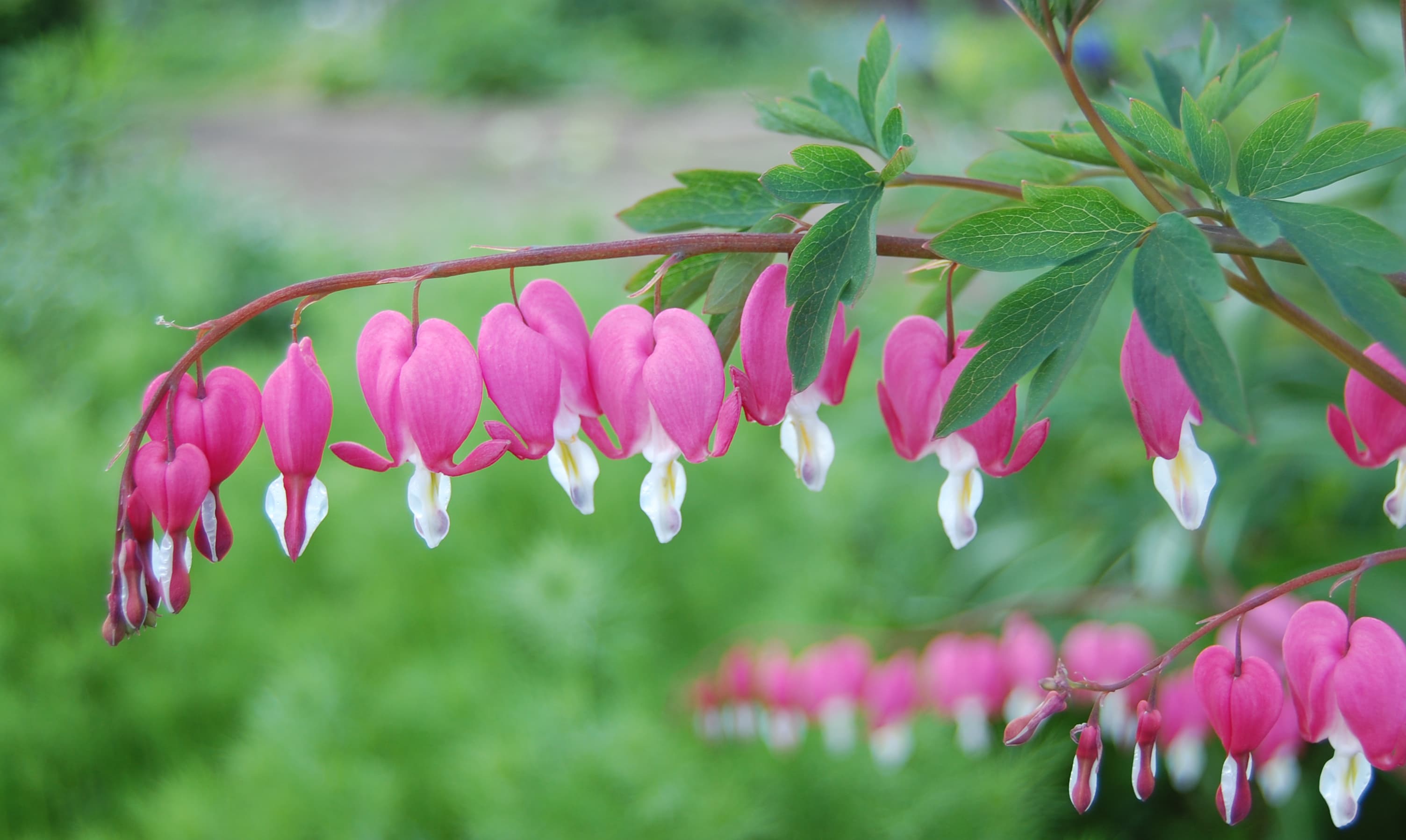
Bleeding heart 'Alba'
Dicentra spectabilis 'Alba'
Dutch: Wit gebroken hartje
Wit gebroken hartje (Dicentra spectabilis 'Alba') is a perennial from the Papaveraceae family that grows up to 90cm tall. This plant thrives in partial shade to shade and requires low maintenance. Blooms in spring and late spring and early summer with white flowers and attracts bees.
60–90 cm
45–60 cm
partial shade, full shade
moderate
loam, clay soil
low maintenance
spring, late spring, early summer
white
Ecologische waarde
Verzorgingskalender
| Taak | Jan | Feb | Mrt | Apr | Mei | Jun | Jul | Aug | Sep | Okt | Nov | Dec |
|---|---|---|---|---|---|---|---|---|---|---|---|---|
| 🌱Planten | ||||||||||||
| ✂️Snoeien | ||||||||||||
| 💧Bemesten |
Care tips
Planting
Dicentra spectabilis 'Alba', the white-flowered bleeding heart, thrives in partial to full shade, making it ideal for woodland gardens, shaded borders, or beneath deciduous trees. Plant in March, April, September, or October when the soil is workable and not waterlogged. Autumn planting gives roots time to establish before winter, while spring planting allows the plant to settle in before its flowering season. Choose a site with loam or clay soil that retains moisture without becoming boggy. Before planting, dig in plenty of organic matter—well-rotted compost or leaf mould—to improve structure and moisture retention, especially if your soil is heavy clay. The roots are fleshy and brittle, so handle them carefully. Dig a planting hole roughly twice the width of the root ball and deep enough so the crown sits at or just below soil level. Space plants 50 cm apart to allow for their mature spread of 45–60 cm. Position the crown so the growing points are visible at the surface; planting too deep can lead to rot. Backfill with the improved soil, firming gently to eliminate air pockets, and water thoroughly to settle the roots. Apply a 5 cm layer of mulch—bark chips or leaf mould—around the base, keeping it clear of the crown itself. This conserves moisture and suppresses weeds. In exposed sites, the emerging stems can be fragile, so avoid planting where they'll be knocked by foot traffic. Water regularly during the first growing season to help establishment, especially if spring rainfall is light.
Pruning
White bleeding heart requires very little pruning in the traditional sense, but it does need some tidying as the season progresses. The main task comes in July and August, after flowering finishes and the foliage begins to yellow and die back naturally. This is a normal part of the plant's life cycle—Dicentra spectabilis is summer-dormant, retreating underground once temperatures rise and day length shortens. In July, once the leaves have turned completely yellow or brown, cut the stems down to ground level using clean secateurs or garden snips. Don't be tempted to remove foliage while it's still green, even if it looks tatty; the plant needs this time to photosynthesise and replenish energy reserves in the roots for next year's growth. Cutting back prematurely can weaken the plant over time. If the foliage collapses messily before it has fully died back, you can trim it to neaten the appearance, but leave as much green material as possible. Once cut down, the space left behind can look bare, so plan companion planting with late-summer perennials or ferns that will fill the gap. There's no need for deadheading to prolong flowering; the blooms appear on arching stems in a set sequence and removing spent flowers won't encourage more. However, if you prefer a tidier look during the flowering period in late spring and early summer, you can snip off individual faded flower racemes. This is purely cosmetic and won't harm the plant.
Maintenance
White bleeding heart is low-maintenance once established, but consistent moisture is key to keeping it healthy. Water regularly during spring, especially in dry spells, as the plant is actively growing and flowering. The soil should stay evenly moist but never waterlogged—clay and loam soils usually retain moisture well, but check during prolonged dry periods. After the foliage dies back in midsummer, watering can stop; the dormant roots need far less moisture and too much can encourage rot. Feed in March or April as new shoots emerge, using a balanced granular fertiliser (such as blood, fish and bone) or a general-purpose organic feed. Scatter a handful around the base of each plant and lightly fork it into the soil surface, then water in. Avoid high-nitrogen feeds, which promote soft, lush growth at the expense of flowers. A second, lighter feed in early April can be beneficial if your soil is poor, but it's not essential. Refresh the mulch layer each spring to suppress weeds and conserve moisture. Leaf mould or well-rotted compost works well and gradually improves soil structure. Dicentra spectabilis 'Alba' is fully hardy to zone 3, so overwintering in temperate Europe is straightforward. The crown will survive frost underground without protection. Mark the spot after dieback so you don't accidentally dig into it while dormant. Pests are rarely a problem. Slugs and snails may nibble emerging shoots in early spring; use organic pellets, barriers, or hand-pick in the evening. Powdery mildew can occasionally appear on foliage in hot, dry conditions, but it's usually cosmetic and disappears once the plant goes dormant.
More about this plant
Combines well with
Related guides
Bleeding heart 'Alba' in your garden design?
Make a free garden design with AI advice. Our AI knows Bleeding heart 'Alba' and 130+ other plants.
Start free design