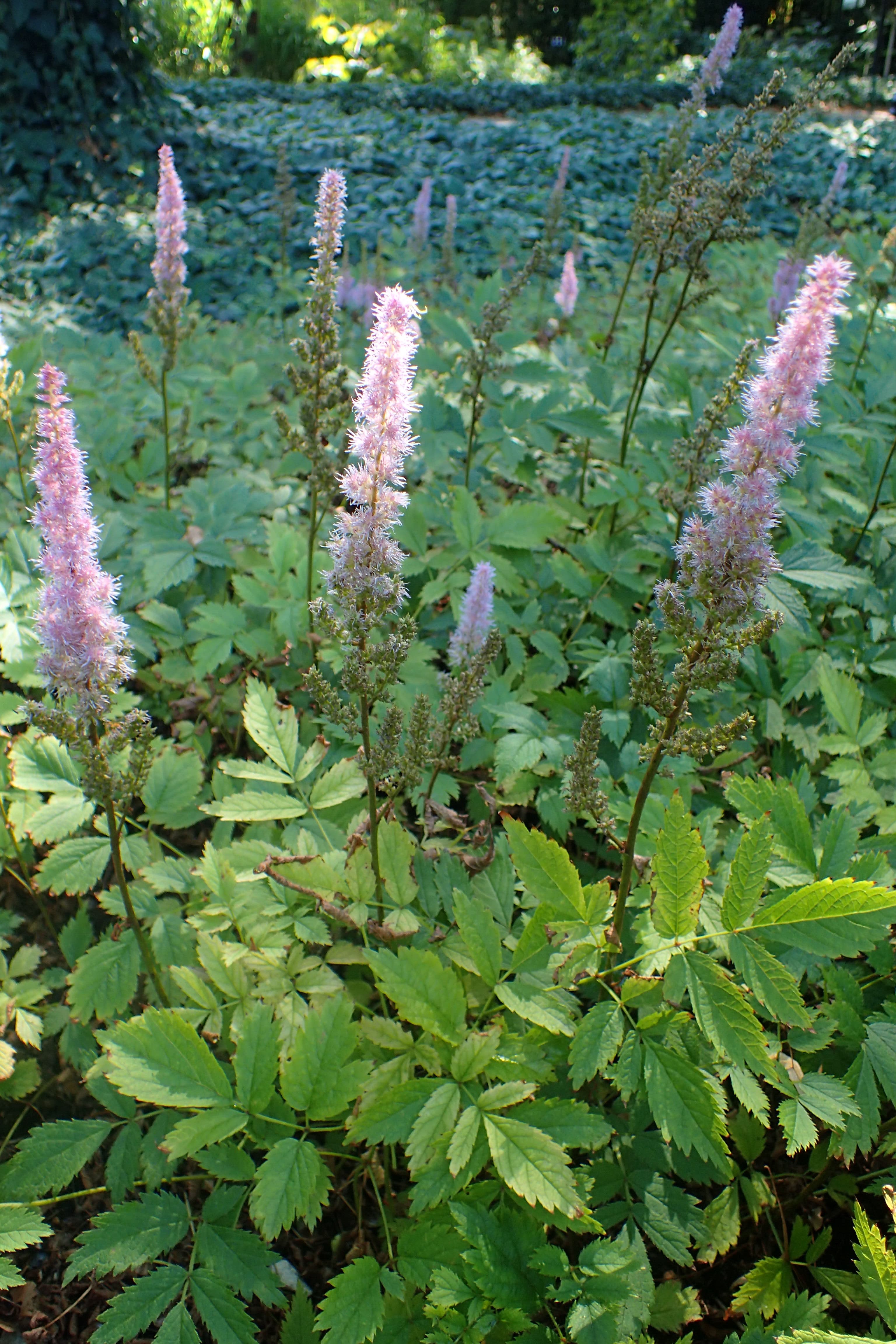
Chinese astilbe 'Pumila'
Astilbe chinensis 'Pumila'
Dutch: Prachtspirea 'Pumila'
Prachtspirea 'Pumila' (Astilbe chinensis 'Pumila') is a perennial from the Saxifragaceae family that grows up to 30cm tall. This plant thrives in partial shade to shade and requires low maintenance. Blooms in late summer with pink, purple flowers and attracts bees and butterflies.
25–30 cm
30–40 cm
partial shade, full shade
moderate
loam, clay soil
low maintenance
late summer
pink, purple
Ecologische waarde
Verzorgingskalender
| Taak | Jan | Feb | Mrt | Apr | Mei | Jun | Jul | Aug | Sep | Okt | Nov | Dec |
|---|---|---|---|---|---|---|---|---|---|---|---|---|
| 🌱Planten | ||||||||||||
| ✂️Snoeien | ||||||||||||
| 💧Bemesten |
Care tips
Planting
Astilbe chinensis 'Pumila' thrives in partial to full shade, making it an excellent choice for borders, woodland edges, or the front of shady beds where its compact 25–30 cm height won't be overwhelmed. Plant in March, April, May, September, or October, avoiding periods of frost or waterlogged soil. This astilbe prefers moisture-retentive loam or clay soil, so prepare the planting area by digging in plenty of organic matter—well-rotted compost or leaf mould—to improve structure and water retention, especially if your soil is on the lighter side. Space plants 30 cm apart to allow for their eventual spread of 30–40 cm. Dig a hole slightly larger than the root ball, position the crown so it sits level with the surrounding soil surface, and backfill gently, firming as you go to eliminate air pockets. Planting too deeply can lead to rot, while planting too shallow may expose roots to drying out. Water thoroughly immediately after planting, soaking the root zone to help the plant settle in. Apply a 5 cm layer of organic mulch—bark chips, compost, or leaf mould—around the base, keeping it clear of the crown itself. This mulch conserves moisture, suppresses weeds, and gradually enriches the soil as it breaks down. Spring plantings will establish quickly if kept moist through their first summer; autumn plantings benefit from mulch protection and will root in over winter, ready to put on strong growth the following spring. Astilbe chinensis 'Pumila' is hardy to zone 4, so winter cold is rarely an issue in temperate European gardens.
Pruning
Astilbe chinensis 'Pumila' requires very little pruning, but a couple of seasonal tidy-ups will keep it looking its best and support vigorous growth. The main pruning window falls in March or November, and the approach differs slightly depending on when you choose to act. In November, after flowering has finished and the foliage begins to die back, you can cut the spent flower spikes down to the base if you prefer a tidy winter garden. However, many gardeners leave the dried plumes standing through winter—they provide structure, catch frost beautifully, and offer some shelter for beneficial insects. If you take this route, delay the main cutback until March, just as new growth begins to emerge at the base. In early March, use secateurs or garden shears to remove all the old, dead foliage and flower stems, cutting right down to ground level. This clears the way for fresh shoots and prevents any overwintering pests or fungal spores from lingering on decaying material. Be careful not to damage the emerging crowns as you work. Astilbe chinensis 'Pumila' does not require shaping, thinning, or rejuvenation pruning in the way shrubs do. Deadheading during the flowering season is optional; removing faded blooms won't encourage a second flush, as astilbes flower once in late summer. If clumps become congested after several years and flowering diminishes, lift and divide them in early spring rather than pruning—split the crown with a spade or knife, replant vigorous sections, and discard woody centres.
Maintenance
Astilbe chinensis 'Pumila' is low-maintenance once established, but consistent moisture is the key to success. Water regularly during dry spells, especially from late spring through summer when the plant is in active growth and flowering. The soil should remain evenly moist but not waterlogged; clay and loam soils help, but even these can dry out in prolonged heat. In autumn and winter, natural rainfall is usually sufficient, though newly planted specimens may need occasional watering if conditions are unusually dry. Feed in March, April, or May with a balanced general-purpose fertiliser or a slow-release granular feed sprinkled around the base of the plant. A spring mulch of well-rotted compost or manure serves double duty, feeding the soil and locking in moisture. Avoid high-nitrogen feeds later in the season, as these promote soft growth at the expense of flowers. Refresh the mulch layer each spring, maintaining a 5 cm depth of organic material around (but not touching) the crown. This suppresses weeds, keeps roots cool, and reduces watering frequency during summer. Astilbe chinensis 'Pumila' is hardy to zone 4 and needs no special winter protection in temperate Europe. The crown is fully frost-tolerant, though a mulch layer offers extra insulation in exposed sites. Pests are rarely a problem, but vine weevil larvae can occasionally damage roots in container-grown plants. Powdery mildew may appear on foliage if the soil dries out repeatedly; maintaining consistent moisture and good air circulation around clumps minimises this risk. Slugs sometimes nibble emerging shoots in spring—use organic pellets or barriers if damage is severe.
More about this plant
Combines well with
Related guides
Chinese astilbe 'Pumila' in your garden design?
Make a free garden design with AI advice. Our AI knows Chinese astilbe 'Pumila' and 130+ other plants.
Start free design