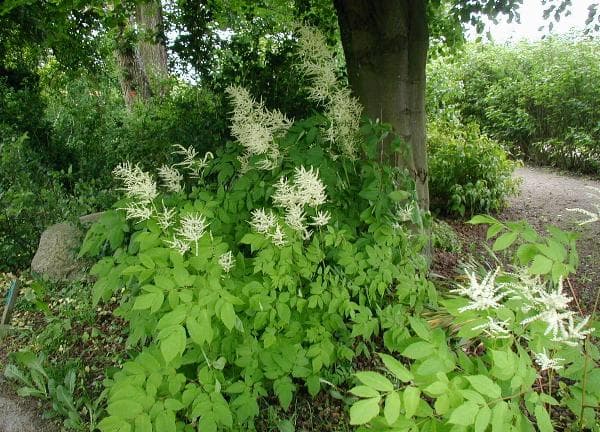
Dwarf goat's beard
Aruncus aethusifolius
Dutch: Geitenbaard
Geitenbaard (Aruncus aethusifolius) is a perennial from the Rosaceae family that grows up to 30cm tall. This plant thrives in partial shade to shade and requires low maintenance. Blooms in early summer and summer with white flowers and attracts bees and butterflies.
25–30 cm
30–40 cm
partial shade, full shade
moderate
loam, clay soil
low maintenance
early summer, summer
white
Ecologische waarde
Verzorgingskalender
| Taak | Jan | Feb | Mrt | Apr | Mei | Jun | Jul | Aug | Sep | Okt | Nov | Dec |
|---|---|---|---|---|---|---|---|---|---|---|---|---|
| 🌱Planten | ||||||||||||
| ✂️Snoeien | ||||||||||||
| 💧Bemesten |
Care tips
Planting
Aruncus aethusifolius, the dwarf goat's beard, thrives in partial to full shade, making it ideal for woodland gardens, shady borders, or the front of a shaded bed. It tolerates a range of soils but performs best in moisture-retentive loam or clay that doesn't dry out completely in summer. Avoid hot, dry spots or heavy sun, which will scorch the delicate foliage. Plant in March, April, September, or October when the soil is workable and temperatures are mild. Autumn planting gives roots time to establish before winter, while spring planting suits colder or wetter gardens. Prepare the site by digging in garden compost or well-rotted manure to improve moisture retention, especially if your soil is light or free-draining. Dig a planting hole slightly larger than the root ball and set the crown at the same level it was growing in the pot—burying it too deeply can lead to rot. Space plants 35 cm apart; this compact perennial will spread to 30–40 cm over time, forming neat, low clumps. Firm the soil gently around the roots to eliminate air pockets. Water thoroughly after planting to settle the soil and encourage root contact. Apply a 5 cm layer of organic mulch such as leaf mould, composted bark, or garden compost around the base, keeping it clear of the crown itself. This conserves moisture, suppresses weeds, and mimics the plant's natural woodland floor habitat. Keep the soil consistently moist for the first growing season while the roots establish, especially if planting in spring. Once settled, Aruncus aethusifolius is remarkably unfussy and drought-tolerant for a shade lover.
Pruning
Aruncus aethusifolius requires very little pruning, which is part of its appeal as a low-maintenance perennial. The main task is tidying up spent foliage rather than structural pruning. The plant produces airy plumes of creamy-white flowers in early summer, followed by attractive seed heads that persist into autumn. Many gardeners leave these in place for winter interest and to provide food and shelter for wildlife. Cut back the old foliage and stems in March or November. March is often preferable in colder gardens, as the dead top growth offers some frost protection to the crown over winter and adds structure to the dormant border. If you prefer a tidy garden or live in a milder area, November works well once the foliage has fully died back and turned brown. Use secateurs or garden shears to cut stems down to within a few centimetres of ground level, taking care not to damage emerging shoots if pruning in early spring. There's no need to deadhead during the flowering season unless you dislike the look of fading blooms. Removing spent flowers won't encourage a second flush, as Aruncus flowers once per season. The seed heads are ornamental and turn a pleasing russet-brown, so leaving them is worthwhile. This perennial doesn't require division to stay healthy, but you can lift and divide congested clumps in early spring if you want to propagate or rejuvenate an old plant. Dig up the whole clump, tease or cut it into sections with a sharp spade, and replant immediately, watering well.
Maintenance
Aruncus aethusifolius is a reliably low-maintenance perennial once established. Water regularly during the first growing season to help roots settle in, especially in dry spells. After that, it tolerates short periods of drought thanks to its woodland origins, but performs best with consistent moisture. In summer, water deeply during prolonged dry weather—once a week is usually sufficient if there's no rain. Clay and loam soils retain moisture well, so avoid overwatering, which can lead to root rot. Feed in March or April as new growth emerges. A general-purpose granular fertiliser such as blood, fish and bone, or a balanced slow-release feed, scattered around the base and lightly worked into the soil, is ideal. A single spring feed is enough; this isn't a heavy feeder. Top up the mulch layer each spring with garden compost or leaf mould to suppress weeds, conserve moisture, and add organic matter as it breaks down. Aruncus aethusifolius is fully hardy in zones 4–8 and needs no winter protection in temperate Europe. The top growth dies back completely, and the plant re-emerges reliably each spring. Mulching helps insulate roots in colder winters, but it's not essential. Pests and diseases are rare. Slugs and snails may nibble young shoots in spring, so check regularly and use organic pellets, barriers, or hand-picking if damage occurs. Sawfly larvae occasionally feed on the foliage in summer, leaving skeletonised leaves; remove affected foliage and larvae by hand. Powdery mildew can appear in very dry conditions, but good soil moisture usually prevents it.
More about this plant
Combines well with
Related guides
Dwarf goat's beard in your garden design?
Make a free garden design with AI advice. Our AI knows Dwarf goat's beard and 130+ other plants.
Start free design