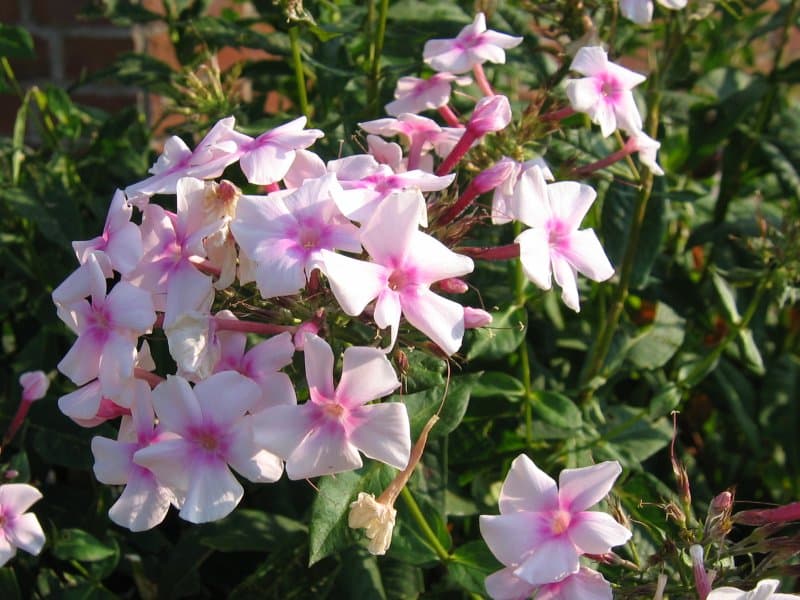
Growing Garden phlox 'Bright Eyes' in a pot
For balcony, patio or terrace — Phlox paniculata 'Bright Eyes'
garden phlox 'Bright Eyes' grows well in a pot of at least Ø 36 cm (37 L capacity), in a position with full sun or partial shade. Watering: every 2 days in summer, once every 2 weeks in winter.
Which pot?
Ø 36 cm
~ 37 L potting soil
Give the plant room with a pot slightly wider than the current rootball, with matching depth.
Watering
every 2 days
once every 2 weeks
Always use a pot with drainage holes. Water dries out faster in pots — or the plant drowns. Check weekly with your finger: only water when the top 2 cm of soil is dry.
Pot care
Water phlox regularly during the growing season, particularly from late spring through summer when flower buds form and open. Aim for one deep soak per week in dry weather, delivering water at the base rather than overhead to keep foliage dry and reduce mildew risk. Clay soils hold moisture longer, so adjust frequency accordingly; loam may need watering twice weekly in hot spells. Reduce watering after flowering finishes in early autumn, and stop altogether once stems are cut back in November. Feed in April with a general-purpose granular fertiliser such as blood, fish and bone, scattering a handful around each clump and lightly forking it into the topsoil. Apply a second feed in May as flower buds develop, and a final liquid tomato feed in June to support flowering. Avoid high-nitrogen feeds after June, which promote soft growth vulnerable to mildew. Powdery mildew is the main problem with border phlox, appearing as white, powdery patches on leaves from mid-summer onwards. Good spacing, thinning shoots in spring, and watering at soil level all help, but some infection is almost inevitable in humid summers. Badly affected leaves can be removed, though mild cases do little harm. Phlox eelworm causes distorted, thickened shoots and stunted growth; dig up and destroy affected plants immediately. Slugs occasionally damage emerging shoots in spring. Refresh the mulch layer each March to suppress weeds and conserve moisture. Phlox is fully hardy in zones 4–8 and needs no winter protection. Divide congested clumps every three to four years in March or October to maintain vigour, replanting only the healthy outer sections.
Pot-specific tip: add slow-release fertiliser pellets in March — potting soil exhausts much faster than open ground.


