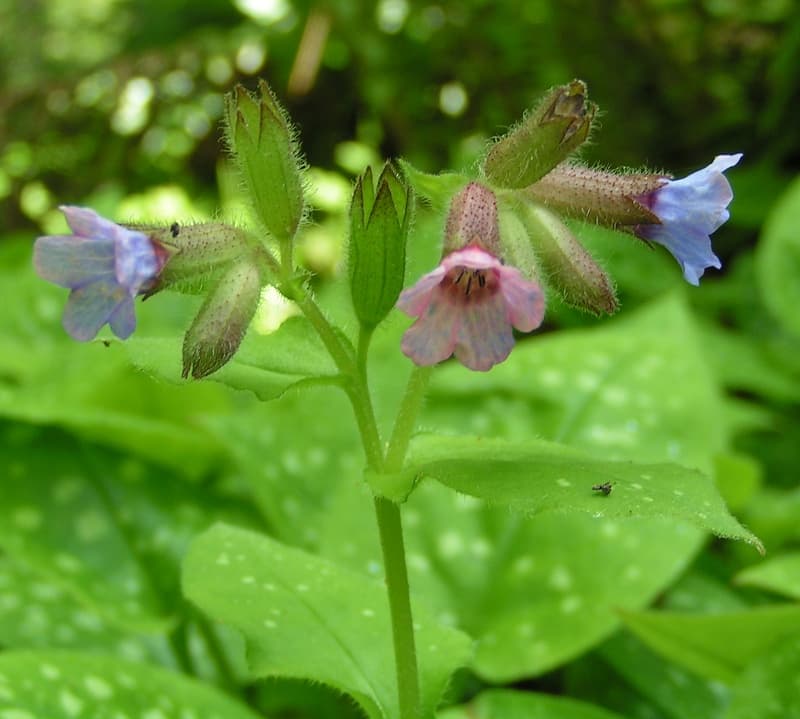
Lungwort 'Sissinghurst White'
Pulmonaria 'Sissinghurst White'
Dutch: Longkruid 'Sissinghurst White'
Longkruid 'Sissinghurst White' (Pulmonaria 'Sissinghurst White') is a perennial from the Boraginaceae family that grows up to 35cm tall. This plant thrives in partial shade to shade and requires low maintenance. Blooms in early spring and spring with white flowers and attracts bees and butterflies.
25–35 cm
30–45 cm
partial shade, full shade
moderate
loam, clay soil
low maintenance
early spring, spring
white
Ecologische waarde
Verzorgingskalender
| Taak | Jan | Feb | Mrt | Apr | Mei | Jun | Jul | Aug | Sep | Okt | Nov | Dec |
|---|---|---|---|---|---|---|---|---|---|---|---|---|
| 🌱Planten | ||||||||||||
| ✂️Snoeien | ||||||||||||
| 💧Bemesten |
Care tips
Planting
Pulmonaria 'Sissinghurst White' thrives in partial or full shade, making it ideal for woodland-style borders, beneath deciduous trees, or on the north side of walls and fences. It tolerates loam and clay soils well, provided they retain moisture without becoming waterlogged. Before planting, dig over the soil to a spade's depth and incorporate plenty of organic matter—well-rotted compost or leaf mould—to improve structure and moisture retention, especially important on heavier clay. Plant in March, April, September, or October. Autumn planting is often preferable because cooler, damper conditions help roots establish before winter, but spring planting works well if you keep plants watered through any dry spells. Dig a hole slightly larger than the root ball, set the crown at soil level (not buried), and firm in gently. Space plants 35 cm apart; they will spread steadily to form attractive clumps 30–45 cm wide. Water thoroughly after planting to settle soil around the roots and eliminate air pockets. Apply a 5 cm layer of organic mulch—bark chips, leaf mould, or garden compost—around (but not touching) the crown to conserve moisture, suppress weeds, and mimic the plant's natural woodland-floor habitat. Pulmonaria dislikes drying out, so keep the soil consistently moist during the first growing season. Staking is unnecessary; the low, clump-forming habit of this perennial is naturally self-supporting. Avoid planting in full sun or exposed, dry positions, where foliage will scorch and growth will be stunted.
Pruning
Pulmonaria 'Sissinghurst White' doesn't require traditional pruning, but it does benefit from a tidy-up in June or July after flowering finishes. The main task is to cut back the old flower stems and any tatty, mildewed, or weather-damaged foliage to ground level. Use clean, sharp secateurs or garden shears. This encourages a fresh flush of attractive, silver-spotted leaves that remain ornamental through summer and autumn, and improves air circulation around the crown, reducing the risk of powdery mildew—a common issue with pulmonarias, especially in dry or crowded conditions. If mildew does appear on older leaves during late spring or early summer, don't hesitate to shear the whole plant back hard to about 5 cm above the crown. New foliage will regrow quickly, usually within a few weeks, and will be healthier and more vigorous. Water well after cutting back and apply a thin mulch to support regrowth. In late autumn or early winter, you can remove any remaining tired foliage, though many gardeners prefer to leave it in place as a natural mulch and tidy up in early spring instead, just before new growth emerges. Avoid cutting into the crown itself. Pulmonaria is a low-maintenance perennial; the key is simply to keep it looking fresh and to manage foliage health rather than shaping or controlling size. Deadheading individual spent flowers isn't necessary—cutting back the whole plant after the main flowering period is far more efficient and effective.
Maintenance
Pulmonaria 'Sissinghurst White' has moderate water needs and dislikes drying out, particularly during spring and summer. Water regularly during dry spells, aiming to keep the soil consistently moist but not saturated. In hot weather or on free-draining soils, check weekly and water deeply rather than little and often. In autumn and winter, natural rainfall is usually sufficient, but don't let the soil become bone-dry even in dormancy. Feed in March or April as new growth begins. Scatter a general-purpose granular fertiliser (such as blood, fish and bone or Growmore) around the base of the plant, or apply a 3–5 cm top-dressing of well-rotted compost or leaf mould. This supports healthy foliage and flowering. Avoid high-nitrogen feeds, which promote soft, mildew-prone growth. A spring mulch also helps retain moisture and suppress weeds. Pulmonaria is fully hardy in zones 4–8 and requires no special winter protection in temperate Europe. Leave the crown undisturbed; it will reshoot reliably each spring. The main pest and disease issue is powdery mildew, which causes a white, dusty coating on leaves, particularly in dry conditions or where air circulation is poor. Prevent it by mulching to retain soil moisture, spacing plants properly, and cutting back affected foliage promptly in June or July. Slugs and snails occasionally nibble young leaves in spring; use organic pellets, barriers, or hand-picking if damage is severe. Otherwise, this is a low-maintenance, long-lived perennial that rewards minimal intervention with reliable early-spring flowers and handsome foliage.
More about this plant
Combines well with
Related guides
Lungwort 'Sissinghurst White' in your garden design?
Make a free garden design with AI advice. Our AI knows Lungwort 'Sissinghurst White' and 130+ other plants.
Start free design