Purple toadflax in March: monthly care
Month-by-month care — Linaria purpurea
In March your purple toadflax needs attention: plant / sow and prune.
- Plant / sow
- Prune
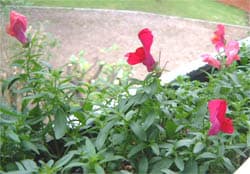
What to do this March
Vlasleeuwenbek thrives in full sun or partial shade and tolerates a wide range of well-drained soils, including loam, sandy, and chalky types. It's particularly happy in lighter, free-draining ground and will struggle in heavy clay that stays wet. Choose a spot where it can self-seed freely if you want a naturalistic effect, or somewhere you can easily remove unwanted seedlings. Plant container-grown plants in March, April, or May for establishment before summer, or in September and October to take advantage of autumn rains and give roots time to settle before winter. Space plants 30 cm apart to allow for their upright, clumping habit and 30–45 cm spread at maturity. Prepare the soil by removing weeds and digging in a little garden compost or grit if drainage is poor, but avoid over-enriching the ground—vlasleeuwenbek performs best in moderately fertile conditions and can become floppy in overly rich soil. Dig a planting hole slightly larger than the root ball, set the plant at the same depth it sat in its pot, and firm the soil gently around the roots. Water thoroughly after planting to settle the soil and eliminate air pockets. A light mulch of gravel or grit around the base helps suppress weeds and improves drainage at the crown, which is especially useful on heavier soils. Avoid organic mulches that retain too much moisture. Newly planted vlasleeuwenbek needs regular watering for the first few weeks, but once established it is quite drought-tolerant and requires little fuss.
Vlasleeuwenbek doesn't require heavy pruning, but a couple of well-timed cuts will keep plants tidy, encourage repeat flowering, and prevent excessive self-seeding. The main pruning window is after the first flush of flowers fades in mid to late summer, and again in March or October depending on your approach. Deadhead spent flower spikes regularly throughout the flowering season—from early summer through to late summer—by cutting stems back to just above a set of leaves. This encourages side shoots to develop and prolongs the display. If you want to allow some self-seeding (vlasleeuwenbek seeds freely and seedlings often appear in cracks and gravel), leave a few spikes to set seed in late summer, then cut them down once seeds have dispersed. In October, after flowering has finished, cut the whole plant back by about half to tidy it up before winter. Alternatively, leave the stems standing for structure and wildlife interest, then cut back hard to ground level in March as new growth begins to emerge at the base. March pruning also gives you a chance to remove any winter-damaged or dead stems. Use clean secateurs or garden shears for all cuts. Vlasleeuwenbek has wiry, upright stems that are easy to cut through. If clumps become congested or start to die out in the centre after a few years, lift and divide them in March or October, replanting only the vigorous outer sections.