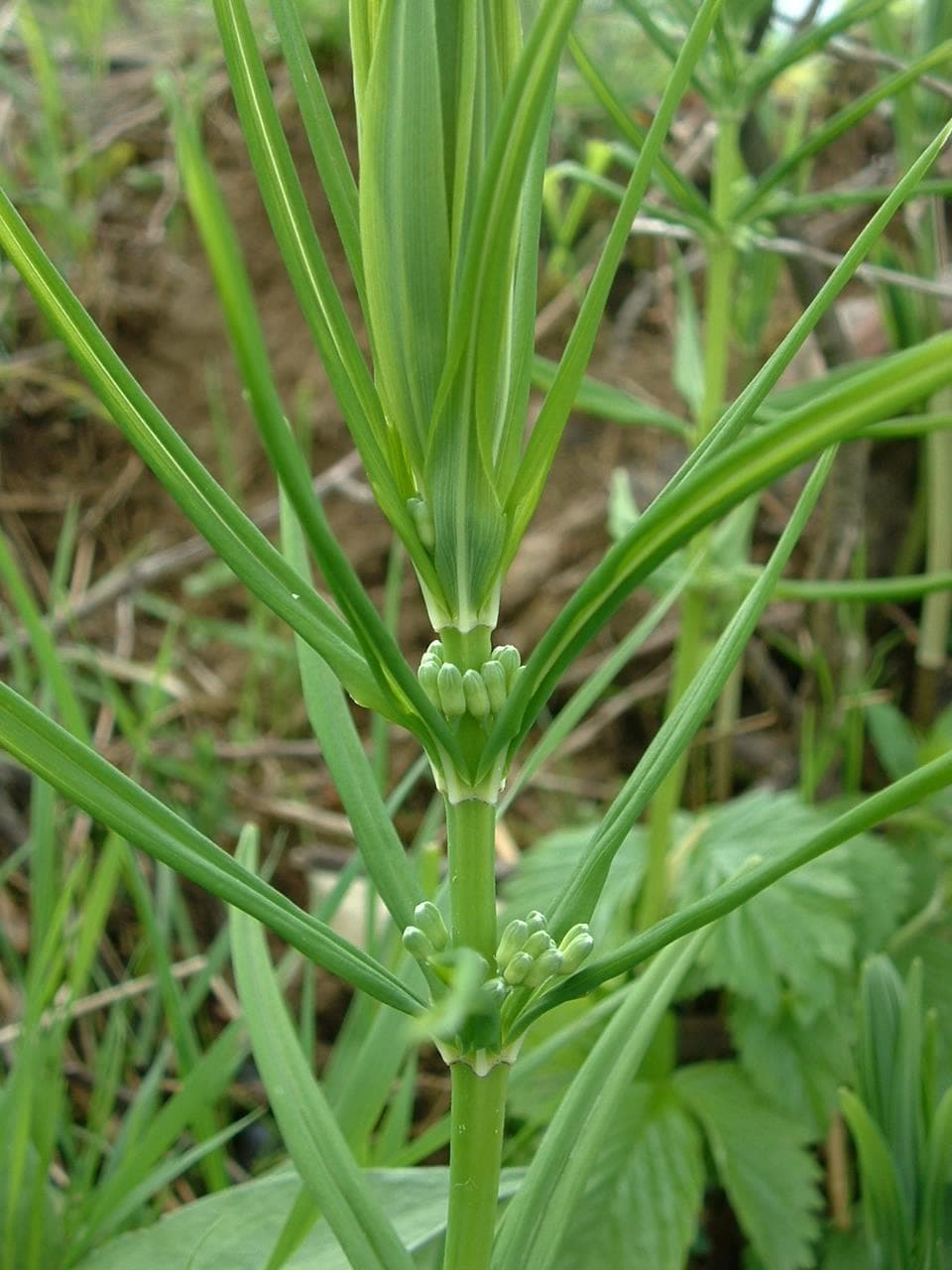
Solomon's seal
Polygonatum × hybridum
Dutch: Salomonszegel
Salomonszegel (Polygonatum × hybridum) is a perennial from the Asparagaceae family that grows up to 80cm tall. This plant thrives in partial shade to shade and requires low maintenance. Blooms in late spring and early summer with white flowers and attracts bees.
60–80 cm
30–45 cm
partial shade, full shade
moderate
loam, clay soil
low maintenance
late spring, early summer
white
Ecologische waarde
Verzorgingskalender
| Taak | Jan | Feb | Mrt | Apr | Mei | Jun | Jul | Aug | Sep | Okt | Nov | Dec |
|---|---|---|---|---|---|---|---|---|---|---|---|---|
| 🌱Planten | ||||||||||||
| ✂️Snoeien | ||||||||||||
| 💧Bemesten |
Care tips
Planting
Solomon's seal (Polygonatum × hybridum) thrives in partial to full shade, making it an excellent choice for woodland gardens, shady borders, or beneath deciduous trees. It tolerates a range of soils but performs best in moisture-retentive loam or clay that doesn't dry out completely in summer. Avoid planting in hot, sunny spots or very dry, sandy ground. Plant rhizomes in March, April, September, or October, when the soil is workable and temperatures are mild. Autumn planting is often preferable because it allows the roots to establish before winter, but spring planting works well if you keep new plants watered through their first summer. Dig a hole about 5–8 cm deep and lay the rhizome horizontally with any growing points facing upwards. Space plants 40 cm apart to allow the clumps to expand gradually over the years without crowding. Before planting, improve heavy clay by forking in garden compost or well-rotted manure to aid drainage, though Solomon's seal tolerates clay better than many perennials. In lighter soils, add organic matter to boost moisture retention. After planting, firm the soil gently around the rhizome and water thoroughly to settle it in and eliminate air pockets. Apply a 5 cm layer of leaf mould, garden compost, or bark mulch around the planting area to conserve moisture, suppress weeds, and mimic the plant's natural woodland floor habitat. Keep the mulch clear of emerging shoots in spring. Water regularly during the first growing season if rainfall is sparse, especially in late spring when the arching stems and foliage are developing rapidly.
Pruning
Solomon's seal requires very little pruning in the traditional sense. The plant dies back naturally in autumn, and the main task is tidying up the old foliage rather than shaping or controlling growth. In November, once the leaves have turned yellow and begun to collapse, cut the stems down to ground level using secateurs or garden shears. Removing this spent growth keeps the border tidy and reduces the risk of pests and diseases overwintering in dead plant material. If you prefer a more naturalistic look, you can leave the stems standing until late winter, but they become tatty and slimy as they decompose, so most gardeners prefer to clear them in November. There's no need to cut back earlier in autumn—allow the foliage to die back fully so the rhizomes can reabsorb nutrients before winter dormancy. Throughout the growing season, no pruning is needed. The graceful arching stems should be left intact; cutting them back while green will weaken the plant and spoil its elegant form. If individual stems are damaged by wind, pests, or accidental breakage, you can remove them at the base, but this is rarely necessary. Deadheading the small white bell-shaped flowers that appear in late spring and early summer is not required. The flowers are followed by blue-black berries in late summer, which add ornamental interest and are enjoyed by birds, so leave them in place unless you're concerned about self-seeding (which is minimal with this hybrid). Focus your November tidy-up on removing all the old stems cleanly at soil level, and your Solomon's seal will re-emerge reliably each spring.
Maintenance
Solomon's seal is genuinely low-maintenance once established. Water regularly during prolonged dry spells in spring and summer, particularly in the first year and when the plant is in active growth from April to June. The arching foliage can wilt if the soil dries out completely, though established clumps tolerate short dry periods better than newly planted rhizomes. In autumn and winter, natural rainfall is usually sufficient. Feed in March or April as new shoots emerge. Scatter a general-purpose granular fertiliser such as blood, fish, and bone or a balanced slow-release feed around the base of each clump, then water in if rain isn't forecast. Alternatively, apply a 3–5 cm mulch of garden compost or well-rotted manure in early spring; this feeds the soil, conserves moisture, and mimics the leaf litter Solomon's seal enjoys in the wild. Avoid high-nitrogen feeds, which promote soft growth at the expense of flowers. The plant is fully hardy to zone 4 and needs no winter protection in temperate Europe. The rhizomes remain dormant underground until spring, when new shoots push through in March or April. The most common pest is the Solomon's seal sawfly (Phymatocera aterrima). The grey larvae strip foliage to skeletons, usually in late spring or early summer. Check the undersides of leaves from May onwards and squash any larvae by hand, or spray with an insecticide suitable for caterpillars if infestations are severe. Sawfly damage is unsightly but rarely fatal; plants recover and return the following year. Clearing away old stems in November helps reduce overwintering pupae. Slugs occasionally nibble emerging shoots in spring; use your preferred slug control if damage is significant.
More about this plant
Combines well with
Related guides
Solomon's seal in your garden design?
Make a free garden design with AI advice. Our AI knows Solomon's seal and 130+ other plants.
Start free design