Turkish mullein in September: monthly care
Month-by-month care — Verbascum bombyciferum
In September your turkish mullein needs attention: plant / sow and prune.
- Plant / sow
- Prune
What to do this September
Verbascum bombyciferum thrives in full sun and well-drained soil, making it ideal for gravel gardens, sunny borders, and Mediterranean-style plantings. It tolerates sandy, loamy, and chalky soils but will not perform well in heavy clay or waterlogged ground. If your soil is prone to sitting wet, dig in plenty of grit or coarse sand before planting to improve drainage. Plant young verbascum in March, April, or May for establishment before summer, or in September and October to give roots time to settle before winter. Space plants 50 cm apart to allow for their eventual spread of 40–60 cm and to ensure good air circulation around the silvery foliage. Dig a hole slightly larger than the root ball, place the plant so the crown sits level with the surrounding soil, and backfill with the excavated soil mixed with a little compost if your ground is very poor. Water in thoroughly after planting to settle the roots, but thereafter verbascum needs very little irrigation thanks to its low water requirement. Avoid planting too deeply, as a buried crown can rot in damp conditions. A light mulch of gravel or grit around the base helps suppress weeds and keeps the neck of the plant dry, which is especially useful over winter. Staking is rarely necessary despite the plant's impressive height of 120–200 cm, as the sturdy flower spikes are naturally robust. Choose a sheltered spot if your garden is very exposed to strong winds, though the plant is generally tough once established.
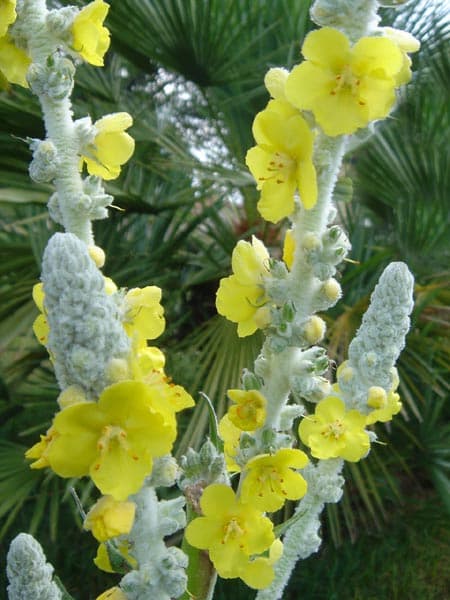
Verbascum bombyciferum is a short-lived perennial that flowers in early summer and summer, producing tall spikes of yellow blooms. The main pruning task is deadheading spent flower spikes in August and September, once flowering has finished. Cut the main flowering stem back to the basal rosette of silvery leaves at ground level using secateurs or loppers, depending on the thickness of the stem. This prevents the plant from setting seed and exhausting itself, and often encourages the production of smaller side shoots that may flower later in the season or the following year. If you want verbascum to self-seed—and it does so readily in well-drained soil—leave one or two spent spikes intact through autumn. The seeds will scatter naturally, and seedlings will appear the following spring. Be aware that seedlings may not come true to type if other verbascum species are growing nearby, but they usually retain the attractive silvery foliage. In late autumn or early spring, tidy the basal rosette by removing any dead, damaged, or rotting leaves, particularly after wet winters. This helps prevent fungal problems and keeps the plant looking tidy. Verbascum bombyciferum is technically a biennial or short-lived perennial, often flowering in its second year and then declining, so don't be surprised if individual plants are not long-lived. However, self-seeding usually ensures continuity. No other pruning is required; the plant's natural architecture is part of its charm.