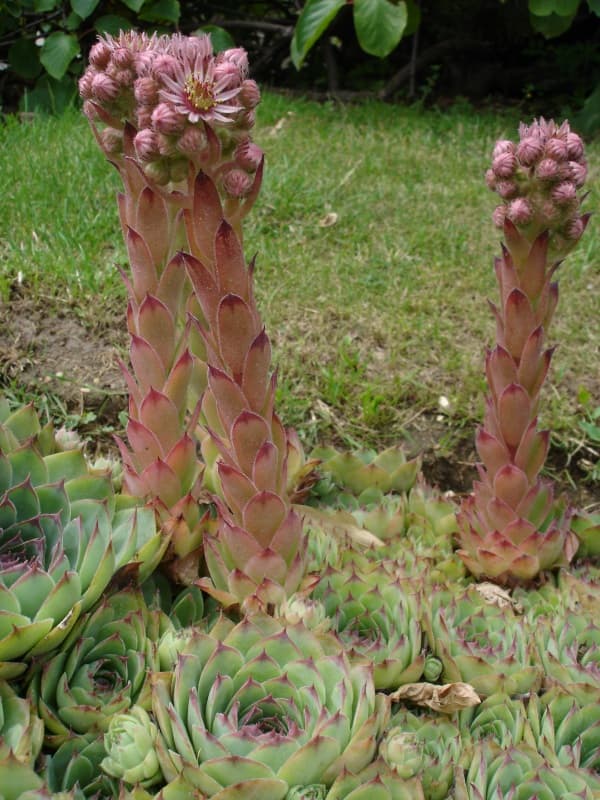
Common houseleek
Sempervivum tectorum
Dutch: Huislook
Huislook (Sempervivum tectorum) is a evergreen ground cover from the Crassulaceae family that grows up to 15cm tall. This plant thrives in full sun and requires low maintenance. Blooms in summer with pink, red flowers and attracts bees.
5–15 cm
15–30 cm
full sun
low water needs
sandy soil, chalky soil
low maintenance
summer
pink, red
Ecologische waarde
Verzorgingskalender
| Taak | Jan | Feb | Mrt | Apr | Mei | Jun | Jul | Aug | Sep | Okt | Nov | Dec |
|---|---|---|---|---|---|---|---|---|---|---|---|---|
| 🌱Planten |
Care tips
Planting
Common houseleek is one of the easiest succulents to establish outdoors in temperate climates. Plant from April through June or in September, avoiding the hottest weeks of summer and the coldest months when the ground may be frozen or waterlogged. Choose a spot in full sun—houseleeks tolerate partial shade but produce their best colour and most compact rosettes in bright, unobstructed light. Soil preparation is critical: houseleeks demand excellent drainage and will rot in heavy, moisture-retentive ground. Sandy or chalky soils are ideal. If your soil is clay or loam, work in plenty of horticultural grit or sharp sand to open up the structure, or plant in raised beds, rockeries, or the crevices of dry-stone walls where water drains away quickly. A thin, poor soil is no problem—houseleeks thrive in lean conditions and actually perform better than in rich ground. Space rosettes 15 cm apart. Planting depth is shallow: scrape away a small depression, set the base of each rosette so the lowest leaves just touch the soil surface, and firm gently around the roots. Don't bury the rosette itself or it may rot. If planting offsets (the small "chicks" that form around the parent rosette), simply press them lightly into the soil surface; they root readily on contact. Water sparingly immediately after planting to settle roots, then leave them alone. Houseleeks establish quickly and need no further watering in most temperate climates. Mulching is unnecessary and can trap moisture against the rosettes, so leave the soil surface bare or top-dress lightly with fine gravel for a tidy finish.
Pruning
Common houseleek requires no pruning in the conventional sense. The plant grows as a tight rosette of fleshy leaves that naturally maintains its own shape, and there are no stems, branches, or woody growth to cut back. Your main task is light tidying rather than pruning. After a rosette flowers—typically in summer, sending up a thick stalk topped with pink or red star-shaped blooms—that individual rosette will die. This is normal monocarpic behaviour. Once the flower stalk has browned and dried completely, usually by late summer or early autumn, pull or cut away the spent rosette and its stalk at the base. Use your fingers or a pair of secateurs; the dead material lifts away easily. Removing it keeps the planting tidy and makes space for the offsets (daughter rosettes) that will have formed around the parent during the growing season. These offsets naturally fill gaps and spread to form dense mats over time. If your houseleeks are becoming overcrowded or you want to control their spread, gently tease away excess offsets in spring or early autumn and replant them elsewhere or discard them. No tools are needed—offsets detach with a light tug. Occasionally, lower leaves on a rosette will shrivel and brown, especially after dry spells. You can pluck these away by hand to keep plants looking neat, but it's not essential. Avoid cutting into healthy green growth. Because houseleeks are evergreen and grow slowly, there's no seasonal pruning window to observe and no risk of cutting off next year's flowers—maintenance is minimal and can be done whenever you notice spent material.
Maintenance
Common houseleek is famously undemanding. Once established, it needs almost no intervention and thrives on neglect. Watering is rarely necessary in temperate climates; natural rainfall is usually sufficient. The fleshy leaves store water, and the plant is adapted to drought. Water only during prolonged dry spells in the first few weeks after planting, and even then very sparingly. Overwatering or sitting in damp soil is the main cause of rot, so err on the side of dryness. Feeding is not required. Houseleeks grow naturally on poor, rocky ground and actually prefer lean conditions. Fertiliser encourages soft, lush growth that is prone to rot and reduces the plant's hardiness and characteristic compact form. The database specifies no feeding months, and you should follow that guidance—don't feed at all. Houseleeks are evergreen and fully hardy to zone 3, so they need no winter protection in temperate Europe. The rosettes remain attractive year-round, often taking on red or purple tints in cold weather. They tolerate frost, snow, and exposure without damage. Pests are uncommon. Vine weevil larvae occasionally chew roots, causing rosettes to collapse; if you suspect this, lift affected plants, destroy larvae, and replant healthy offsets in fresh grit. Aphids may cluster on flower stalks in summer but rarely cause serious harm. Rot caused by poor drainage or overhead watering is the main issue—ensure water drains freely and avoid wetting rosettes when watering nearby plants. Mulching is unnecessary and undesirable, as organic mulch holds moisture against the base of rosettes. A top-dressing of fine gravel improves appearance and drainage but isn't essential. Maintenance level is genuinely low—an annual tidy and occasional division are all that's needed.
More about this plant
Combines well with
Related guides
Common houseleek in your garden design?
Make a free garden design with AI advice. Our AI knows Common houseleek and 130+ other plants.
Start free design