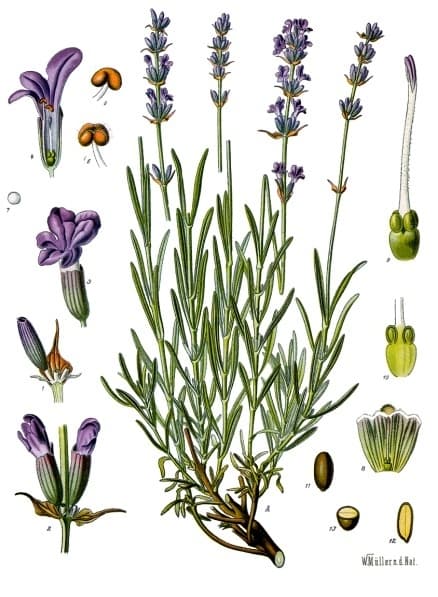
English Lavender
Lavandula angustifolia 'Hidcote'
Dutch: Lavendel 'Hidcote'
Lavendel 'Hidcote' (Lavandula angustifolia 'Hidcote') is a evergreen, edible perennial from the Lamiaceae family that grows up to 50cm tall. This plant thrives in full sun and requires low maintenance. Blooms in summer with purple flowers and attracts bees and butterflies.
30–50 cm
30–50 cm
full sun
low water needs
sandy soil, chalky soil, loam
low maintenance
summer
purple
Ecologische waarde
Verzorgingskalender
| Taak | Jan | Feb | Mrt | Apr | Mei | Jun | Jul | Aug | Sep | Okt | Nov | Dec |
|---|---|---|---|---|---|---|---|---|---|---|---|---|
| 🌱Planten | ||||||||||||
| ✂️Snoeien |
Care tips
Planting
English lavender 'Hidcote' thrives in full sun and demands excellent drainage, making it ideal for sandy, chalky, or loamy soils. Before planting, work in horticultural grit or sharp sand if your soil is heavy or clay-based—waterlogged roots will kill lavender faster than cold weather. Choose a spot that receives at least six hours of direct sunlight daily; shade leads to leggy growth and poor flowering. Plant in April, May, or September when the soil is workable and temperatures are moderate. Autumn planting gives roots time to establish before winter, but spring planting works well if you can water during dry spells in the first summer. Dig a hole slightly larger than the root ball and set the plant at the same depth it sat in its pot—burying the stem too deeply invites rot. Space plants 40 cm apart to allow air circulation, which helps prevent fungal disease. After planting, firm the soil gently around the base and water in well to settle roots. Despite lavender's low water needs once established, new plants need regular watering for the first six to eight weeks until roots spread. After that, water only during prolonged drought. Apply a 2–3 cm layer of gravel or grit mulch around the base—this reflects light, keeps the neck of the plant dry, and suppresses weeds. Avoid organic mulches like compost or bark, which retain moisture and can cause stem rot. No staking is needed; 'Hidcote' forms a compact, sturdy mound naturally.
Pruning
Lavandula angustifolia 'Hidcote' needs pruning twice a year to maintain its compact shape and encourage vigorous flowering. Without regular pruning, plants become woody, bare at the base, and produce fewer blooms. The first prune comes in August or September, immediately after flowering finishes. Use clean, sharp secateurs or garden shears to cut back the spent flower stems along with about 2–3 cm of the soft green growth beneath them. This deadheading prevents the plant wasting energy on seed production and keeps it tidy through autumn. Don't cut into the old brown wood at this stage—just trim the leafy green growth. The main structural prune happens in March, as new growth begins to emerge at the base. Cut back all the previous year's growth by about one-third to one-half, shaping the plant into a neat dome. Again, avoid cutting into thick, bare, woody stems, as lavender rarely regenerates from old wood. If you can see fresh green shoots lower down, you can prune just above them. This spring trim stimulates bushy new growth and plenty of flower buds for summer. If your 'Hidcote' has become very woody and gappy, it's usually better to replace it than attempt hard renovation pruning. Young plants are inexpensive and establish quickly. Always prune on a dry day to reduce the risk of fungal infection entering cut stems.
Maintenance
Once established, English lavender 'Hidcote' is remarkably undemanding. Water sparingly—only during prolonged summer drought when the soil is bone-dry. Overwatering causes root rot and yellowing foliage. In typical British and Irish weather, rainfall is usually sufficient except in very dry spells. The plant's silvery foliage and low water need make it perfect for gravel gardens and exposed, free-draining sites. Feeding is not necessary and often counterproductive. Lavender evolved in poor Mediterranean soils and too much fertility produces soft, floppy growth with fewer flowers and reduced fragrance. If your soil is extremely poor, a light sprinkle of general-purpose fertiliser in early spring is the absolute maximum—but most gardeners can skip feeding entirely. 'Hidcote' is evergreen and fully hardy in zones 5a–9a, sailing through winter without protection in temperate Europe. Good drainage is far more important than cold protection; wet winter soil kills more lavender than frost. Avoid cutting back in autumn, as the old growth protects the crown. The gravel mulch applied at planting helps keep the base dry through winter. Pests rarely trouble lavender—its aromatic oils repel most insects. Rosemary beetle (with metallic green-and-purple stripes) occasionally nibbles foliage in late summer; pick them off by hand. The main disease risk is root rot from poor drainage or overwatering. Watch for grey mould (botrytis) on stems in damp conditions; improve air circulation and avoid overhead watering. Refresh the gravel mulch every few years to maintain good drainage around the crown.
More about this plant
Combines well with
Related guides
English Lavender in your garden design?
Make a free garden design with AI advice. Our AI knows English Lavender and 130+ other plants.
Start free design