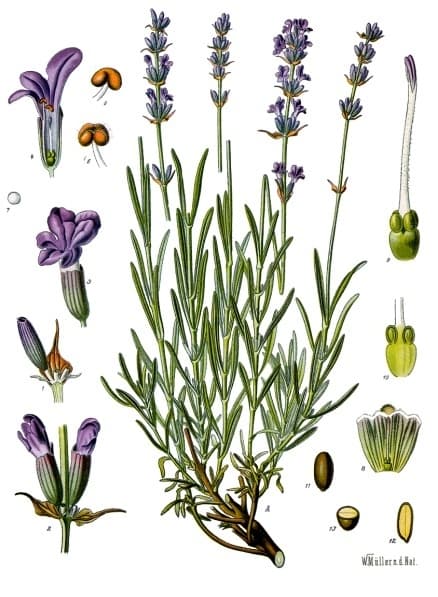
English lavender 'Munstead'
Lavandula angustifolia 'Munstead'
Dutch: Lavendel 'Munstead'
Lavendel 'Munstead' (Lavandula angustifolia 'Munstead') is a evergreen, edible perennial from the Lamiaceae family that grows up to 45cm tall. This plant thrives in full sun and requires low maintenance. Blooms in late spring and early summer and summer with purple flowers and attracts bees and butterflies.
30–45 cm
40–60 cm
full sun
low water needs
sandy soil, loam, chalky soil
low maintenance
late spring, early summer, summer
purple
Ecologische waarde
Verzorgingskalender
| Taak | Jan | Feb | Mrt | Apr | Mei | Jun | Jul | Aug | Sep | Okt | Nov | Dec |
|---|---|---|---|---|---|---|---|---|---|---|---|---|
| 🌱Planten | ||||||||||||
| ✂️Snoeien | ||||||||||||
| 💧Bemesten | ||||||||||||
| 🍎Oogsten |
Care tips
Planting
Lavandula angustifolia 'Munstead' thrives in full sun and demands excellent drainage, so choose a spot that receives at least six hours of direct sunlight daily. This compact lavender tolerates sandy soil, loam, and chalky conditions but will sulk or rot in heavy clay or anywhere waterlogged. If your soil is dense, work in plenty of horticultural grit or sharp sand before planting—aim for at least a third grit by volume in the planting hole. Plant in March, April or May for the growing season ahead, or in September and October so roots establish before winter. Space plants 40 cm apart centre to centre; they'll knit together into a low, aromatic hedge within two seasons. Dig a hole no deeper than the root ball—lavender resents being buried too deeply—and slightly wider. Tip the plant out of its pot, tease out any circling roots gently, and set it so the top of the root ball sits level with or just proud of the surrounding soil. Backfill with the excavated soil mixed with grit, firm gently with your hands, and water in well to settle roots. After planting, water every few days for the first fortnight if conditions are dry, then taper off; once established, 'Munstead' needs very little supplementary water. A thin mulch of gravel or grit around the base helps suppress weeds, reflects light up into the foliage, and keeps the neck of the plant dry, reducing the risk of fungal rot. Avoid organic mulches like compost or bark, which hold moisture against the stems.
Pruning
Lavandula angustifolia 'Munstead' needs pruning twice a year to stay compact, floriferous, and long-lived. The first and most important prune happens in March or April, just as new green shoots appear at the base of the old stems. Using clean, sharp secateurs or shears, cut back all the previous year's growth by about one-third to one-half, shaping the plant into a low, rounded mound. Always cut into the leafy green growth, never back into bare, woody stems—lavender rarely regenerates from old wood and a hard cut into brown stems can kill the plant. This spring prune encourages bushy new growth and plenty of flower spikes. The second prune comes in August, immediately after the main flowering flush. Deadhead by cutting off all the spent flower stalks along with an inch or two of leafy stem beneath them. This tidy-up prevents the plant wasting energy on seed production, keeps it neat, and often triggers a modest second flush of late-summer flowers. Again, stay in the green growth. If you've inherited an old, leggy lavender with a bare, woody base, renovation is risky; it's usually better to take cuttings and start afresh. Young plants respond well to pruning, so begin the routine in the first spring after planting. Use sharp tools to avoid bruising stems, and choose a dry day—wet foliage and open cuts invite fungal disease.
Maintenance
Once established, 'Munstead' lavender is remarkably self-sufficient. Water sparingly: in a typical year, rainfall alone suffices. During prolonged summer drought, a deep soak every two to three weeks is enough—overwatering causes root rot and yellowing foliage. In autumn and winter, stop watering entirely unless the plant is in a container. Feed lightly in March or April with a general-purpose granular fertiliser, such as blood, fish and bone, scattered around the base at a handful per plant. Alternatively, use a slow-release balanced feed. Avoid high-nitrogen fertilisers, which promote soft, sappy growth prone to frost damage and poor flowering. Lavender evolved on poor Mediterranean hillsides and actually flowers better in lean soil, so resist the urge to overfeed. 'Munstead' is evergreen and fully hardy in zones 5–9, requiring no winter protection in temperate Europe. Good drainage is far more critical to winter survival than cold itself—wet soil kills lavender faster than frost. In exposed gardens, a gravel mulch helps, but avoid covering the foliage. Pests are few: rosemary beetle and its larvae occasionally chew foliage in late summer; pick them off by hand. The main disease risk is root rot (Phytophthora) in poorly drained soil, which causes sudden wilting and browning. Prevention is key—there's no cure once rot sets in. Powdery mildew can appear in humid, crowded conditions; ensure good air circulation and avoid overhead watering. Harvest flower spikes in June, July or August just as the lowest florets open, cutting in the morning after dew has dried for the best fragrance.
More about this plant
Pruning english lavender 'Munstead'
When and how
Caring for english lavender 'Munstead'
Position, watering, feeding
When to plant english lavender 'Munstead'?
Best month and spacing
Harvesting english lavender 'Munstead'
Harvest months and storage tips
Growing english lavender 'Munstead' in a container
For balcony or patio
Combines well with
Related guides
English lavender 'Munstead' in your garden design?
Make a free garden design with AI advice. Our AI knows English lavender 'Munstead' and 130+ other plants.
Start free design