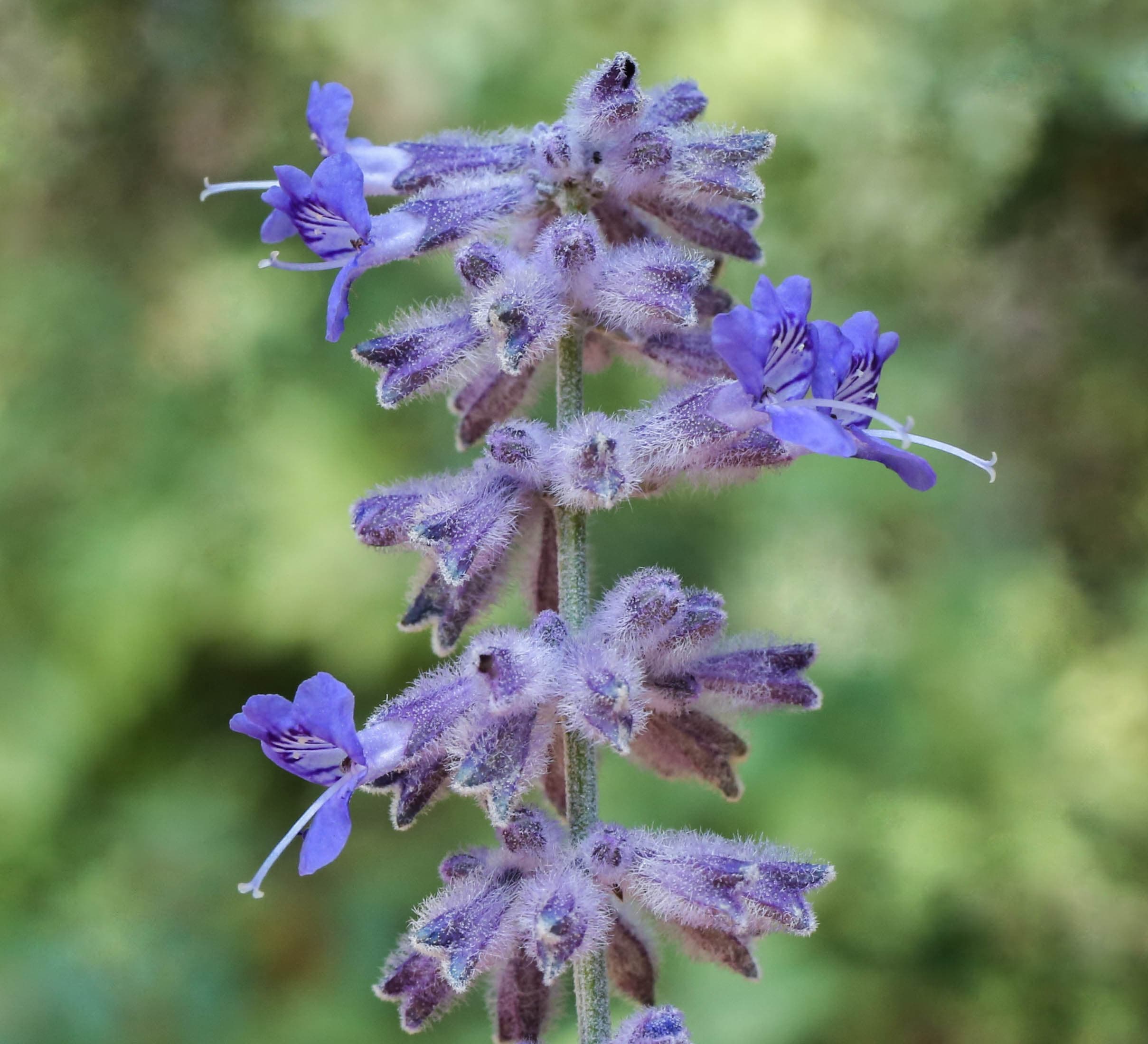
Russian sage
Perovskia atriplicifolia
Dutch: Russische salie
Russische salie (Perovskia atriplicifolia) is a perennial from the Lamiaceae family that grows up to 120cm tall. This plant thrives in full sun and requires low maintenance. Blooms in summer and late summer with blue, purple flowers and attracts bees and butterflies.
60–120 cm
60–90 cm
full sun
low water needs
sandy soil, loam, chalky soil
low maintenance
summer, late summer
blue, purple
Ecologische waarde
Verzorgingskalender
| Taak | Jan | Feb | Mrt | Apr | Mei | Jun | Jul | Aug | Sep | Okt | Nov | Dec |
|---|---|---|---|---|---|---|---|---|---|---|---|---|
| 🌱Planten | ||||||||||||
| ✂️Snoeien | ||||||||||||
| 💧Bemesten |
Care tips
Planting
Russian sage thrives in full sun and free-draining soil, making it an excellent choice for hot, dry spots where many other perennials struggle. Choose a position that receives at least six hours of direct sunlight daily; shade will result in weak, floppy growth and reduced flowering. The plant tolerates sandy soil, loam, and chalky soil equally well, but drainage is critical—waterlogged roots in winter will kill it. Prepare the planting area by digging in grit or horticultural sand if your soil is heavy clay, aiming to improve drainage rather than fertility. Russian sage actually performs better in lean soil; overly rich conditions produce lush foliage at the expense of flowers and can make stems flop. Dig a hole roughly twice the width of the root ball and the same depth, so the crown sits level with the surrounding soil surface. Planting too deep encourages stem rot. Plant in March, April or May for the best establishment before summer, or in September and October if your soil drains freely and winters are not excessively wet. Space plants 60 cm apart; they will fill out to 60–90 cm wide by their second or third season. After planting, firm the soil gently around the roots and water in thoroughly to settle them. A 5 cm layer of gravel or grit mulch around the base helps suppress weeds and keeps the crown dry, which is especially useful on heavier soils. Avoid organic mulches like compost or bark, which retain moisture and can encourage rot. Newly planted Russian sage needs regular watering for the first few weeks, but once established it requires very little attention.
Pruning
Russian sage flowers on new growth produced in spring, so annual hard pruning is essential to keep plants compact, floriferous, and tidy. Left unpruned, the woody base becomes increasingly gnarled and the plant sprawls outward with sparse flowering at the tips. Prune in March or April, just as the new green shoots begin to emerge low down on the old stems. Pruning earlier in winter can expose tender new growth to frost damage; waiting until late spring delays flowering. Use sharp secateurs or loppers and cut all the previous year's growth back hard to within 10–15 cm of the ground, just above the lowest visible buds or new shoots. Don't worry about cutting into old wood—Russian sage responds well to this treatment and will quickly produce vigorous new stems. If your plant has become very woody and overgrown, you can rejuvenate it by cutting even harder, down to 5 cm, though flowering may be slightly delayed that year. Remove all the pruned stems and foliage; they can go on the compost heap or be disposed of. After pruning, the plant will look like a collection of stubby brown sticks, but fresh silvery-grey foliage will soon appear. If you garden in a very mild area and want to tidy up in autumn, you can remove the spent flower spikes after flowering finishes, but leave the main framework of stems intact until spring. This provides some winter structure and protects the crown from excessive wet. Avoid autumn hard pruning, as it stimulates soft growth that won't survive winter frosts.
Maintenance
Once established, Russian sage is remarkably drought-tolerant and needs watering only during prolonged dry spells in summer. Overwatering is far more dangerous than underwatering; soggy soil, especially in winter, causes root and crown rot. In a typical temperate European summer, established plants usually manage on rainfall alone. Newly planted specimens need regular watering through their first growing season until roots are well established. Feed sparingly. Apply a light dressing of general-purpose granular fertiliser such as blood, fish and bone in April or May, scattering a small handful around the base of each plant. Avoid high-nitrogen feeds, which promote soft leafy growth prone to flopping and reduce the intensity of flowering. On poor sandy or chalky soils, a single spring feed is sufficient; on richer loam, you can skip feeding altogether. Russian sage evolved in the steppes of Central Asia and performs best when slightly stressed. The plant is fully hardy to zone 5 and sails through winters in zones 7–9 without protection. Good drainage is the key to winter survival, not temperature. Mulch with gravel rather than organic matter to keep the crown dry. Russian sage suffers few pests or diseases. Powdery mildew can occasionally appear on foliage in humid, still conditions, but it rarely causes serious harm and usually clears as air circulation improves. Aphids sometimes cluster on new spring growth; a strong jet of water or a spray of insecticidal soap deals with them easily. Slugs and snails ignore the aromatic foliage. Deadheading is unnecessary; the spent flower spikes remain attractive well into autumn and provide winter interest.
More about this plant
Combines well with
Related guides
Russian sage in your garden design?
Make a free garden design with AI advice. Our AI knows Russian sage and 130+ other plants.
Start free design