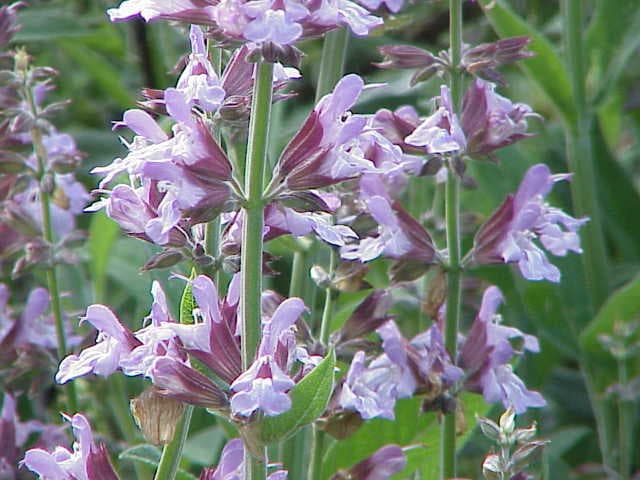
Sage
Salvia officinalis
Dutch: Salie
Salie (Salvia officinalis) is a evergreen, edible herb from the Lamiaceae family that grows up to 80cm tall. This plant thrives in full sun and requires low maintenance. Blooms in early summer and summer with purple, blue flowers and attracts bees and butterflies.
30–80 cm
40–80 cm
full sun
low water needs
sandy soil, loam, chalky soil
low maintenance
early summer, summer
purple, blue
Ecologische waarde
Verzorgingskalender
| Taak | Jan | Feb | Mrt | Apr | Mei | Jun | Jul | Aug | Sep | Okt | Nov | Dec |
|---|---|---|---|---|---|---|---|---|---|---|---|---|
| 🌱Planten | ||||||||||||
| ✂️Snoeien | ||||||||||||
| 💧Bemesten | ||||||||||||
| 🍎Oogsten |
Care tips
Planting
Sage thrives in full sun and well-drained soil, making it ideal for sunny borders, herb gardens, or large containers. It tolerates sandy, loamy, and chalky soils but will not survive in heavy, waterlogged ground. Before planting, work in some grit or horticultural sand if your soil is clay-heavy to improve drainage. A slightly alkaline to neutral pH suits sage well. Plant young sage plants in April, May, or September. Spring planting gives plants a full season to establish, while autumn planting works if your soil drains freely and winters are not excessively wet. Dig a hole slightly larger than the root ball, set the plant at the same depth it was growing in its pot, and firm the soil gently around the roots. Space plants 50 cm apart to allow for their mature spread of 40–80 cm and to ensure good air circulation, which helps prevent fungal problems. Water newly planted sage thoroughly to settle the soil, then water sparingly. Sage has low water needs and established plants tolerate drought well. Overwatering, especially in winter, is a common cause of failure. If planting in a container, use a loam-based compost mixed with extra grit and ensure the pot has drainage holes. Mulching is generally unnecessary and can trap moisture around the base, encouraging rot. In exposed gardens, a light mulch of gravel around the plant can help suppress weeds and reflect heat, which sage appreciates. Avoid rich, moisture-retentive soils or shaded positions, as these lead to leggy, weak growth and poor flavour.
Pruning
Sage benefits from regular pruning to maintain a compact, bushy shape and prevent it becoming woody and bare at the base. Prune in April or May, once the risk of hard frost has passed and new growth is visible. Avoid pruning in autumn or winter, as this stimulates soft growth that can be damaged by frost, and sage is evergreen so retains its leaves year-round. In spring, cut back about one-third of the previous year's growth, trimming stems just above a pair of healthy leaves or a visible bud. Use clean, sharp secateurs to make neat cuts. Focus on removing any dead, damaged, or frost-blackened shoots first, then shape the plant by shortening leggy stems. The aim is to encourage branching and keep the plant dense and productive. Never cut back into old, bare wood at the base, as sage is reluctant to regenerate from very old stems. If your sage has become very woody or neglected, resist the temptation to prune it hard all at once. Instead, renovate it gradually over two or three years, removing no more than a third of the growth each spring. Very old, unproductive plants are often best replaced. Throughout the growing season, pinch out the tips of young shoots to encourage bushiness and delay flowering if you want to prioritise leaf production. However, sage flowers in early summer and are attractive to bees, so many gardeners leave some stems to bloom. Deadheading spent flowers tidies the plant but is not essential.
Maintenance
Sage is a low-maintenance herb once established. Water sparingly, only during prolonged dry spells in summer, as sage tolerates drought well and dislikes wet roots. In autumn and winter, avoid watering altogether unless the plant is in a container, in which case water very occasionally to prevent the compost drying out completely. Overwatering in cold, wet months is the most common cause of root rot and plant death. Feed lightly in April with a general-purpose granular fertiliser or a handful of blood, fish, and bone scattered around the base. Sage grows naturally on poor, stony soils and does not need rich feeding. Over-fertilising produces lush, soft growth with less flavour and reduced hardiness. A single spring feed is sufficient for the entire year. Sage is hardy in zones 5–9 and overwinters outdoors in temperate Europe without protection. However, it dislikes sitting in cold, wet soil, so ensure drainage remains good through winter. In heavy clay areas or very exposed sites, consider growing sage in a raised bed or container that can be moved to a sheltered spot. Evergreen foliage can be harvested year-round, though growth slows in winter. Sage is generally trouble-free but can occasionally suffer from powdery mildew in humid conditions or if air circulation is poor. Thin out congested growth and avoid overhead watering. Capsid bugs may cause distorted leaves in summer; pick off affected growth. Rosemary beetle, which also feeds on sage, can be removed by hand. Mulch is rarely needed, but a gravel mulch around Mediterranean herbs like sage can improve drainage and reflect warmth.
More about this plant
Combines well with
Related guides
Sage in your garden design?
Make a free garden design with AI advice. Our AI knows Sage and 130+ other plants.
Start free design