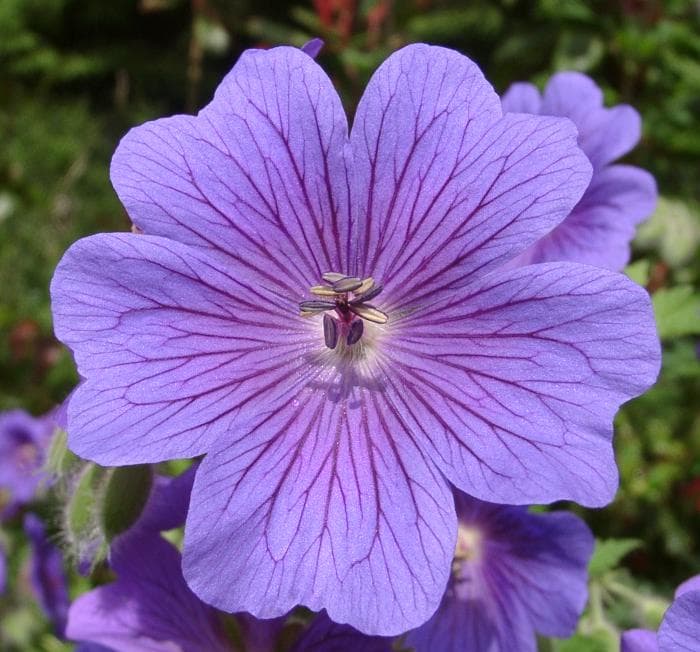
Showy geranium
Geranium × magnificum
Dutch: Ooievaarsbek (Geranium × magnificum)
Ooievaarsbek (Geranium × magnificum) (Geranium × magnificum) is a perennial from the Geraniaceae family that grows up to 60cm tall. This plant thrives in full sun to partial shade and requires low maintenance. Blooms in late spring and early summer with blue, purple flowers and attracts bees and butterflies.
40–60 cm
50–70 cm
full sun, partial shade
moderate
loam, clay soil, sandy soil
low maintenance
late spring, early summer
blue, purple
Ecologische waarde
Verzorgingskalender
| Taak | Jan | Feb | Mrt | Apr | Mei | Jun | Jul | Aug | Sep | Okt | Nov | Dec |
|---|---|---|---|---|---|---|---|---|---|---|---|---|
| 🌱Planten | ||||||||||||
| ✂️Snoeien | ||||||||||||
| 💧Bemesten |
Care tips
Planting
Geranium × magnificum thrives in full sun or partial shade, making it a versatile choice for borders, cottage gardens, and ground cover. It tolerates a wide range of soil types—loam, clay, and sandy soils—provided drainage is reasonable. Before planting, dig over the soil to a spade's depth and work in a handful of garden compost or well-rotted manure to improve structure and fertility, especially on thin sandy soils or heavy clay. Plant in March, April, September, or October. Autumn planting allows roots to establish before winter, while spring planting suits colder, wetter sites. Space plants 50 cm apart to allow for their mature spread of 50–70 cm; they will knit together to form a weed-suppressing clump within a couple of seasons. Dig a planting hole slightly wider and deeper than the root ball. Set the crown at soil level—not buried, not proud—and firm the soil gently around the roots to eliminate air pockets. Water thoroughly after planting to settle the soil, even if the ground is already moist. Apply a 5 cm layer of garden compost or bark mulch around the base, keeping it clear of the crown itself, to conserve moisture and suppress weeds while the plant establishes. If planting in spring during a dry spell, water weekly for the first month. Autumn-planted geraniums usually need little additional watering unless the season is exceptionally dry. No staking is required; the clump-forming habit is sturdy and self-supporting, even when the foliage reaches its full height of 40–60 cm.
Pruning
Geranium × magnificum flowers in late spring and early summer, producing a spectacular display of blue to purple blooms. Once flowering finishes, prune in July or August to tidy the plant and encourage fresh foliage. This hybrid geranium does not reliably rebloom after deadheading, so pruning is primarily about maintaining a neat appearance and promoting healthy basal growth for the following year. Use a pair of sharp garden shears or secateurs. Cut back all the flowering stems and old foliage to within a few centimetres of the ground, just above the crown where you will see new shoots beginning to emerge. This may feel drastic, but hardy geraniums respond vigorously. Within a few weeks, a fresh mound of green leaves will appear, remaining attractive through autumn and often taking on red or bronze tints as temperatures drop. If you prefer a less severe approach, you can simply shear off the spent flower stems immediately after blooming and leave the foliage intact, then cut back tired leaves in late summer if they look tattered. However, a single hard cut in July or August is quicker and results in tidier regrowth. Do not prune in autumn or winter. The semi-evergreen foliage provides some winter interest and protects the crown from frost. Clear away any dead or damaged leaves in early spring before new growth begins, but avoid cutting into live tissue at that stage. This light spring tidy-up takes only a few minutes.
Maintenance
Geranium × magnificum is a low-maintenance perennial once established. Water moderately during the growing season; the plant tolerates short dry spells but performs best with consistent moisture in spring and early summer when flowering. In prolonged dry weather, water deeply once a week rather than little and often. Reduce watering after the July or August cut-back, as the fresh foliage requires less moisture. In autumn and winter, natural rainfall is usually sufficient. Feed in March or April as growth resumes. Scatter a general-purpose granular fertiliser such as blood, fish and bone or Growmore around the base at the rate recommended on the packet—typically a small handful per plant. Rake it lightly into the soil surface and water if the ground is dry. Avoid high-nitrogen feeds, which promote soft leafy growth at the expense of flowers. No further feeding is necessary during the season. This geranium is fully hardy in zones 4–8 and requires no winter protection in temperate Europe. The crown may die back partially in severe winters, but it reliably regenerates in spring. Mulch lightly in autumn with garden compost to insulate roots on exposed sites, but keep mulch away from the crown to prevent rot. Pests and diseases are rare. Occasionally, vine weevil larvae may damage roots in container-grown plants; check for notched leaf edges and treat with a biological control if needed. Powdery mildew can appear on foliage in dry summers, particularly in crowded plantings; improve air circulation and water at the base rather than overhead. Slugs may nibble young spring shoots; use organic pellets or barriers if damage is severe.
More about this plant
Combines well with
Related guides
Showy geranium in your garden design?
Make a free garden design with AI advice. Our AI knows Showy geranium and 130+ other plants.
Start free design