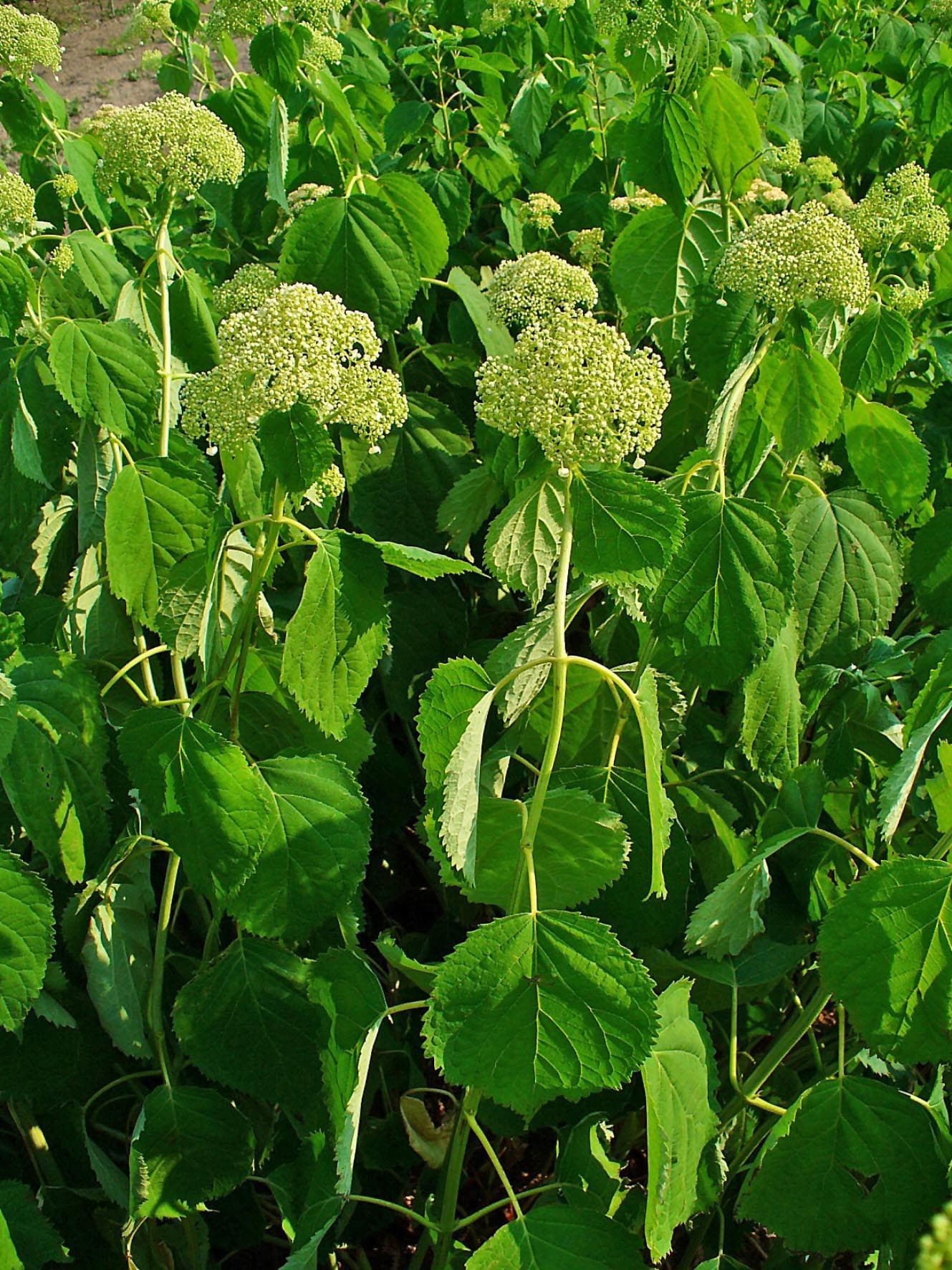
Smooth Hydrangea
Hydrangea arborescens 'Annabelle'
Dutch: Sneeuwbalhortensia
Sneeuwbalhortensia (Hydrangea arborescens 'Annabelle') is a shrub from the Hydrangeaceae family that grows up to 150cm tall. This plant thrives in partial shade to full sun and requires low maintenance. Blooms in summer with white flowers and attracts bees and butterflies.
100–150 cm
100–150 cm
partial shade, full sun
high water needs
loam, clay soil
low maintenance
summer
white
Ecologische waarde
Verzorgingskalender
| Taak | Jan | Feb | Mrt | Apr | Mei | Jun | Jul | Aug | Sep | Okt | Nov | Dec |
|---|---|---|---|---|---|---|---|---|---|---|---|---|
| 🌱Planten | ||||||||||||
| ✂️Snoeien | ||||||||||||
| 💧Bemesten |
Care tips
Planting
Smooth hydrangea 'Annabelle' thrives in partial shade or full sun, though in hotter spots some afternoon shade helps prevent the large white blooms from scorching. Choose a sheltered position if possible, as the heavy flower heads can be damaged by strong winds. The soil should be moisture-retentive loam or clay; this hydrangea dislikes dry conditions, so avoid free-draining sandy soils unless you're prepared to water frequently. Plant in March, April, September, or October when the soil is workable and not waterlogged. Dig a hole twice the width of the root ball and roughly the same depth. Break up any compacted soil at the base and incorporate a generous amount of well-rotted compost or manure to improve moisture retention. Position the plant so the top of the root ball sits level with the surrounding soil—planting too deep can lead to stem rot. Space plants 120 cm apart if you're creating a hedge or group planting; 'Annabelle' will reach 100–150 cm in both height and spread, so give it room to develop its natural rounded shape. After planting, backfill with the excavated soil mixed with compost, firm gently with your heel to eliminate air pockets, then water thoroughly. Apply a 5–8 cm layer of organic mulch such as composted bark or leaf mould around the base, keeping it a few centimetres clear of the stems. This mulch conserves moisture and suppresses weeds. Water again if the weather is dry over the following fortnight to help establishment.
Pruning
Prune smooth hydrangea 'Annabelle' in March, just as the buds begin to swell but before new growth properly starts. This hydrangea flowers on the current season's wood, so spring pruning won't sacrifice blooms—in fact, it encourages stronger stems and larger flower heads. You can prune hard without worry. Use clean, sharp secateurs or loppers. For a tidy, compact shrub, cut all stems back to about 30–50 cm from the ground, just above a pair of healthy buds. This hard pruning produces vigorous new shoots that carry the big white blooms in summer. If you prefer a larger, more informal shape, you can prune more lightly, removing only a third to half of each stem's length, but be aware that lighter pruning often results in more but smaller flowers, and the stems may flop under the weight of the blooms. Always remove any dead, damaged, or crossing branches entirely, cutting back to the base or to a strong outward-facing bud. If your plant has become congested, thin out a few of the oldest stems at ground level to improve air circulation. Some gardeners leave the dried flower heads on over winter for structure and interest, then remove them during the March prune—this is perfectly fine and won't harm the plant. Avoid autumn or winter pruning, as this can expose tender new growth to frost damage.
Maintenance
Smooth hydrangea 'Annabelle' has high water needs, especially during dry spells in spring and summer when it's producing foliage and flowers. Water deeply once or twice a week in dry weather, soaking the root zone rather than sprinkling lightly. Mulch helps retain moisture, so top up the organic mulch layer each spring if it has broken down. In autumn and winter, rainfall is usually sufficient, but check containerised plants or those under eaves. Feed in March with a general-purpose balanced fertiliser such as blood, fish and bone, scattering a handful around the base and lightly forking it in. Apply a second feed in April as growth accelerates, then a final dose in June to support flowering. Avoid high-nitrogen feeds after midsummer, as they promote soft growth vulnerable to frost. 'Annabelle' is fully hardy (zone 3a–9a) and needs no special winter protection in temperate Europe. The stems die back naturally or can be left standing for winter interest, then pruned away in March. Pests are rarely a problem, though aphids occasionally cluster on soft new shoots in spring—a strong jet of water or insecticidal soap deals with them. Powdery mildew can appear on the foliage in dry summers, especially if the roots are stressed; ensure consistent watering and avoid overhead watering late in the day. Leaf spot may occur in wet seasons but is usually cosmetic. Remove and bin affected leaves, and improve air circulation by thinning congested growth during the annual prune.
More about this plant
Combines well with
Related guides
Smooth Hydrangea in your garden design?
Make a free garden design with AI advice. Our AI knows Smooth Hydrangea and 130+ other plants.
Start free design