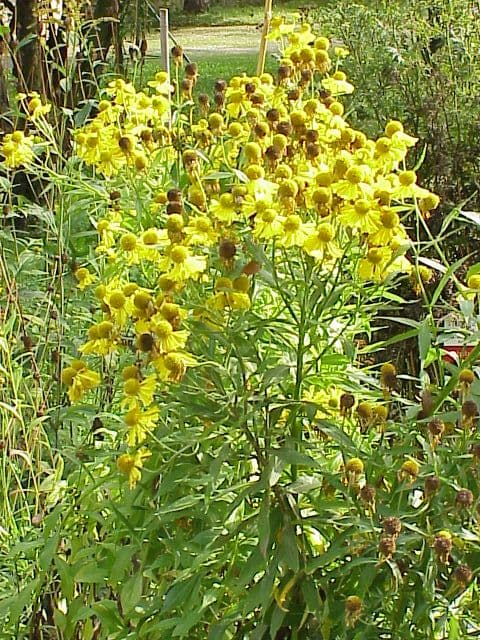
Sneezeweed
Helenium
Dutch: Zonnekruid
Zonnekruid (Helenium) is a perennial from the Asteraceae family that grows up to 150cm tall. This plant thrives in full sun to partial shade and requires low maintenance. Blooms in late summer and autumn with yellow, orange, red flowers and attracts bees and butterflies.
60–150 cm
40–60 cm
full sun, partial shade
high water needs
loam, clay soil
low maintenance
late summer, autumn
yellow, orange, red
Ecologische waarde
Verzorgingskalender
| Taak | Jan | Feb | Mrt | Apr | Mei | Jun | Jul | Aug | Sep | Okt | Nov | Dec |
|---|---|---|---|---|---|---|---|---|---|---|---|---|
| 🌱Planten | ||||||||||||
| ✂️Snoeien | ||||||||||||
| 💧Bemesten |
Care tips
Planting
Helenium thrives in full sun but tolerates partial shade, though flowering may be less prolific in shadier spots. Choose a position with good air circulation to reduce the risk of mildew. The soil should be moisture-retentive loam or clay; helenium dislikes dry, sandy ground. Before planting, dig in plenty of well-rotted compost or manure to improve structure and water-holding capacity, especially if your soil is on the lighter side. Plant helenium in March, April or May for spring planting, or in September and October for autumn planting. Autumn planting gives roots time to establish before winter, but spring planting works well if the soil is workable and not waterlogged. Dig a hole slightly larger than the root ball, set the plant at the same depth it was growing in its pot, and firm the soil gently around the roots. Space plants 50 cm apart to allow for their mature spread of 40–60 cm and to ensure good airflow between clumps. Water thoroughly immediately after planting to settle the soil and eliminate air pockets. Apply a 5 cm layer of organic mulch such as garden compost or bark chips around the base, keeping it clear of the stems to prevent rot. This helps retain moisture—critical for helenium—and suppresses weeds. In exposed gardens or if you're planting taller varieties that will reach 120–150 cm, consider placing supports or linking stakes early in the season; helenium's stems can become top-heavy when in full flower during late summer and autumn.
Pruning
Helenium doesn't require complex pruning, but a couple of seasonal cuts will keep plants tidy and improve performance. In March, as new growth begins to emerge, cut back all the previous year's dead stems to ground level. Use clean secateurs or shears and remove the old growth completely; this tidies the clump and makes way for fresh shoots. March is also the time to divide congested clumps every three to four years—lift the plant, split it into sections with a spade or two forks back-to-back, and replant healthy outer portions. In late May or early June, consider the "Chelsea chop": cut back about one-third to one-half of the stems by roughly a third of their height. This encourages bushier growth, more flower stems, and slightly delays flowering on the pruned stems, extending the overall display into autumn. It also reduces the final height, which can help prevent the need for staking. Deadheading spent flowers throughout the flowering period from late summer into autumn encourages further blooms and keeps the plant looking fresh, though it's not essential. Simply snip off faded flower heads back to the next bud or leaf joint. In November, once flowering has finished and foliage begins to die back, you can cut stems down to around 10–15 cm if you prefer a tidy border over winter. Alternatively, leave the stems standing until March to provide winter structure and shelter for beneficial insects, then clear them away as described above. Either approach works; it's a matter of garden style and preference.
Maintenance
Helenium has high water needs and performs poorly in dry soil. Water regularly throughout the growing season, especially during dry spells in late spring and summer when the plant is building up to its late-summer flowering peak. In clay or loam soils that retain moisture well, weekly deep watering is usually sufficient, but in warm, dry weather you may need to water two or three times a week. Mulching helps considerably by conserving soil moisture. Feed helenium in early spring to support vigorous growth and abundant flowering. In March, apply a general-purpose granular fertiliser such as blood, fish and bone or a balanced NPK feed (e.g. 10-10-10) around the base of the clump, following packet rates. A second, lighter feed in April or early May can be beneficial, particularly on poorer soils. Avoid high-nitrogen feeds later in the season, as these promote soft, leafy growth at the expense of flowers. Helenium is fully hardy in zones 4–8 and requires no special winter protection in temperate Europe. The crown will survive frosts and re-emerge reliably each spring. Mulch around the base in autumn with compost or well-rotted manure to insulate roots and improve soil structure. Common problems include powdery mildew, particularly in dry conditions or where air circulation is poor; ensure adequate watering and avoid overcrowding. Slugs and snails may damage young shoots in spring—use organic pellets, barriers or hand-picking as needed. Aphids occasionally cluster on stems and buds in early summer; a strong jet of water or insecticidal soap usually resolves the issue. Overall, helenium is a robust, low-maintenance perennial that rewards consistent moisture and an annual spring feed with months of vibrant late-season colour.
More about this plant
Combines well with
Related guides
Sneezeweed in your garden design?
Make a free garden design with AI advice. Our AI knows Sneezeweed and 130+ other plants.
Start free design