Pruning Star jasmine
When and how — Trachelospermum jasminoides
Prune your star jasmine in August and September — the optimal month is usually September.
You're in the pruning season right now — grab the secateurs.
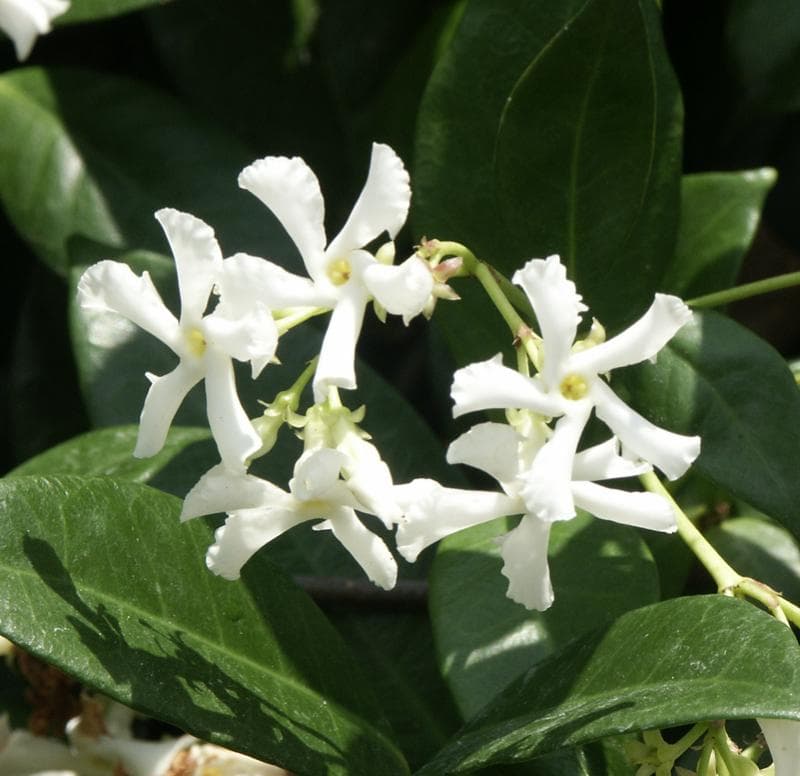
When to prune?
The climber star jasmine is pruned in August and September.
Climber pruning is about structure and keeping space against the support.
Pruning climbers does two things: keeps the plant on its support and lets light and air through. Timing depends heavily on species, and flowering season points the way. Spring-flowering clematis (Group 1, e.g. Clematis montana) is pruned immediately after flowering in May or June; summer-flowering clematis (Group 3, e.g. Clematis viticella) is cut back hard to 30 cm in March. Climbing roses are thinned in February, keeping the horizontally-trained main stems and shortening side-shoots to two or three buds. Wisteria needs two prunings a year (July and winter) — without them it simply won't flower.
How to prune star jasmine
Star jasmine flowers on the previous season's growth, so pruning is best done in August or September, immediately after the main flush of blooms has finished. Pruning at this time allows the plant to produce new shoots that will carry next year's flowers while avoiding any risk of frost damage to fresh growth. This climber doesn't require heavy pruning to stay healthy, but it does benefit from regular tidying to keep it within bounds and encourage dense, bushy growth. Use clean, sharp secateurs or loppers for stems thicker than your thumb. Start by removing any dead, damaged, or diseased stems, cutting back to healthy wood. Then look for wayward shoots that are growing away from the support or into gutters, windows, or neighbouring plants—trim these back to a main stem or suitable side shoot. If your star jasmine has become overgrown or bare at the base, you can renovate it by cutting back harder, removing up to one-third of the oldest stems close to the base. This encourages fresh growth from lower down. Avoid cutting into very old, thick wood all at once; spread major renovation over two or three years to avoid shocking the plant. Throughout the growing season, you can lightly trim or tie in stray shoots to keep the plant tidy, but avoid any significant pruning between October and July, as you'll be removing the stems that carry the fragrant white flowers. If the plant is young and still filling its space, pruning can be minimal—just remove anything dead or damaged and let it grow.
Common mistakes
✗ Skipping the July prune on wisteria
Wisteria flowers freely only if you cut the long whippy shoots back to 5–6 buds from the main framework in July. Skip it and you get plenty of leaf and almost no bloom.
✗ Pruning all clematis the same way
Clematis are divided into Group 1, 2 or 3 — each pruned differently. Group 1 not at all (flowers on old wood), Group 2 lightly in February, Group 3 hard in March. Always check the group before you reach for the secateurs.
✗ Letting climbing roses grow vertically
A climbing rose trained horizontally flowers along its entire length. Trained vertically it only flowers at the top. Plan this from planting time with your support.


