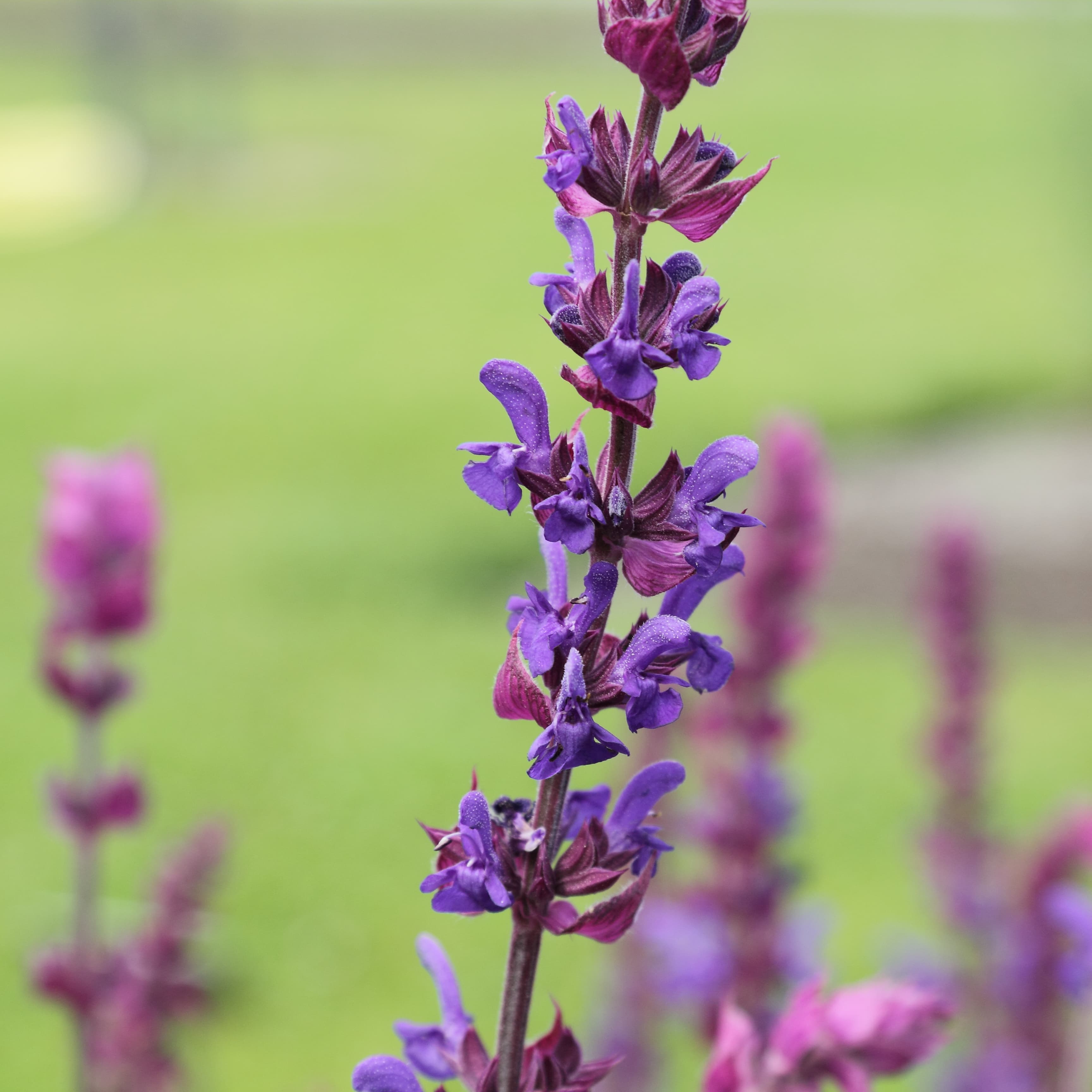
Woodland sage 'Mainacht'
Salvia nemorosa 'Mainacht'
Dutch: Salie 'Mainacht'
Salie 'Mainacht' (Salvia nemorosa 'Mainacht') is a perennial from the Lamiaceae family that grows up to 50cm tall. This plant thrives in full sun to partial shade and requires low maintenance. Blooms in late spring and early summer and summer with purple flowers and attracts bees and butterflies.
40–50 cm
30–40 cm
full sun, partial shade
moderate
loam, sandy soil, chalky soil
low maintenance
late spring, early summer, summer
purple
Ecologische waarde
Verzorgingskalender
| Taak | Jan | Feb | Mrt | Apr | Mei | Jun | Jul | Aug | Sep | Okt | Nov | Dec |
|---|---|---|---|---|---|---|---|---|---|---|---|---|
| 🌱Planten | ||||||||||||
| ✂️Snoeien | ||||||||||||
| 💧Bemesten |
Care tips
Planting
Salvia nemorosa 'Mainacht' thrives in full sun but tolerates partial shade, though flowering may be less profuse in shadier spots. It adapts to a wide range of soils—loam, sandy, or chalky—provided drainage is good. Heavy clay should be improved with grit or coarse sand before planting to prevent waterlogging, which this salvia dislikes. Plant in March, April, or May for the growing season ahead, or in September and October when the soil is still warm enough for roots to establish before winter. Space plants 35 cm apart to allow for their mature spread of 30–40 cm and to ensure good air circulation, which helps prevent mildew. Dig a hole slightly larger than the root ball and loosen the soil at the base to encourage roots to spread. Set the plant at the same depth it sat in its pot—burying the crown too deeply can lead to rot. Backfill with the excavated soil, firming gently to eliminate air pockets, and water thoroughly to settle the roots. After planting, apply a 3–5 cm layer of mulch around the base, keeping it clear of the stems. This conserves moisture and suppresses weeds while the plant establishes. Water regularly for the first few weeks, especially if planting in spring or during dry spells, until you see strong new growth. Autumn-planted salvias need less attention but should not be allowed to dry out completely before winter. No staking is required; the upright flower spikes of 'Mainacht' are sturdy enough to support themselves in all but the most exposed sites.
Pruning
Salvia nemorosa 'Mainacht' flowers from late spring through early summer, and timely pruning encourages a second flush of blooms. The main pruning window is July and August, immediately after the first flowering wave finishes. Use clean, sharp secateurs or garden shears for the job. Cut back the spent flower stems to just above the basal foliage—the low mound of leaves at the base of the plant. This typically means removing about half to two-thirds of the plant's height. Don't be tentative: a firm cut stimulates fresh growth and often results in a second round of purple spikes in late summer or early autumn. If you leave the old flowers in place, the plant puts energy into seed production rather than new blooms, and the overall appearance becomes untidy. In addition to the summer cut, deadhead any stray spent flowers throughout the season to keep the plant looking neat, though this isn't strictly necessary if you're planning the main July or August prune. In late autumn or early winter, after flowering has completely finished and growth has slowed, you can tidy the plant by cutting back all stems to the basal rosette. Some gardeners prefer to leave this final cut until late February or early March, as the old stems provide a little winter protection for the crown and can look attractive when rimmed with frost. Avoid autumn pruning if your area experiences hard frosts early; leaving some top growth helps insulate the roots. Always clear away prunings to reduce the risk of fungal diseases overwintering in debris.
Maintenance
Salvia nemorosa 'Mainacht' is low-maintenance once established and has moderate water needs. Water regularly during the first growing season to help roots settle in, then reduce frequency. In summer, water during prolonged dry spells—once a week is usually sufficient if there's no rain—but avoid overwatering, as salvias tolerate drought better than soggy soil. In autumn and winter, natural rainfall is generally adequate. Feed in March or April as new growth emerges. A general-purpose granular fertiliser such as blood, fish, and bone, applied according to packet instructions, provides a gentle nutrient boost. Alternatively, a balanced slow-release fertiliser works well. Avoid high-nitrogen feeds, which promote leafy growth at the expense of flowers. A single spring application is enough; this salvia doesn't require further feeding through the season. Mulch lightly in spring with garden compost or well-rotted manure, keeping material away from the crown to prevent rot. This improves soil structure and moisture retention, particularly beneficial on sandy soils. 'Mainacht' is hardy to zone 4 and needs no special winter protection in temperate Europe. It may suffer from powdery mildew in humid conditions or where air circulation is poor; spacing plants correctly at planting helps prevent this. If mildew appears, remove affected leaves and avoid overhead watering. Slugs occasionally nibble young spring growth—use organic pellets or barriers if damage is severe. Aphids can cluster on flower buds in early summer but are rarely a serious problem; a strong jet of water usually dislodges them, or encourage natural predators like ladybirds.
More about this plant
Combines well with
Related guides
Woodland sage 'Mainacht' in your garden design?
Make a free garden design with AI advice. Our AI knows Woodland sage 'Mainacht' and 130+ other plants.
Start free design