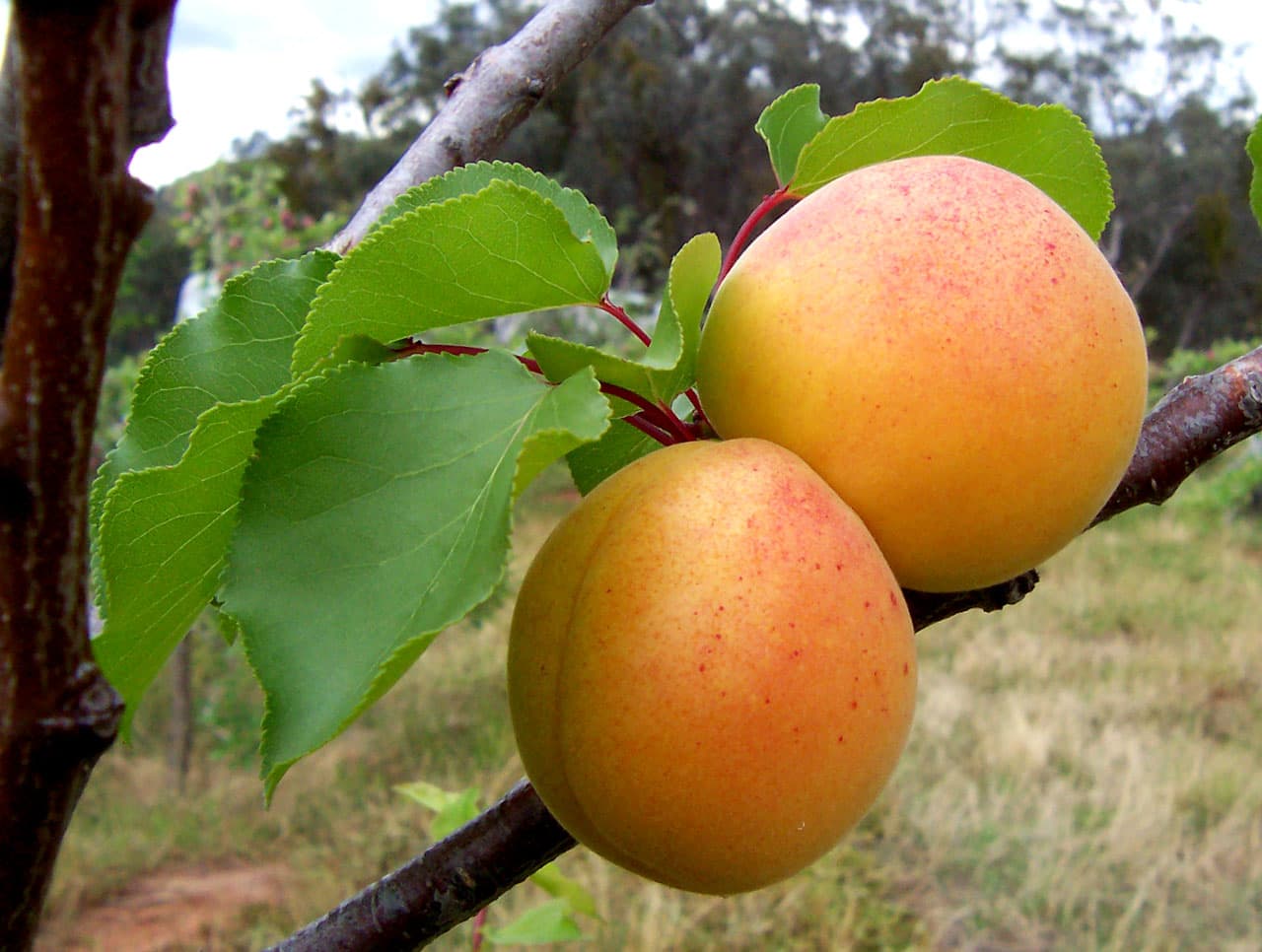
Apricot
Prunus armeniaca
Dutch: Abrikoos
Abrikoos (Prunus armeniaca) is a edible fruit plant from the Rosaceae family that grows up to 6 meters tall. This plant thrives in full sun and requires regular maintenance. Blooms in early spring with white, pink flowers and attracts bees and birds.
300–600 cm
300–500 cm
full sun
moderate
loam, sandy soil
high maintenance
early spring
white, pink
Ecologische waarde
Verzorgingskalender
| Taak | Jan | Feb | Mrt | Apr | Mei | Jun | Jul | Aug | Sep | Okt | Nov | Dec |
|---|---|---|---|---|---|---|---|---|---|---|---|---|
| 🌱Planten | ||||||||||||
| ✂️Snoeien | ||||||||||||
| 💧Bemesten | ||||||||||||
| 🍎Oogsten |
Care tips
Planting
Apricot trees thrive in full sun and need a sheltered position to protect their early spring blossom from frost and cold winds. Choose a south- or southwest-facing wall if possible, as the reflected warmth helps ripen fruit and offers some frost protection. The ideal soil is free-draining loam or sandy soil; apricots dislike waterlogged conditions and will suffer root rot in heavy clay unless you improve drainage with grit and organic matter. Plant bare-root trees between November and March, ideally in November or December while the soil still holds some warmth. Container-grown specimens can go in any time during the planting window, but avoid frozen or waterlogged ground. Dig a hole twice the width of the root ball and deep enough so the graft union sits about 10 cm above soil level. Break up compacted soil at the base and sides of the hole to encourage roots to spread. Space trees 400 cm apart to allow for their mature spread of 300–500 cm. Position the tree so the roots are spread evenly, backfill with the excavated soil mixed with a little well-rotted compost, and firm gently with your heel to eliminate air pockets. Stake young trees with a short stake and flexible tie, angled at 45 degrees to avoid damaging the root ball. Water thoroughly after planting—give at least 10–15 litres—even if the soil feels damp. Apply a 5–7 cm layer of well-rotted manure or garden compost as mulch around the base, keeping it clear of the trunk to prevent rot. This mulch conserves moisture and suppresses weeds while the tree establishes.
Pruning
Apricots fruit on short spurs and on wood produced the previous year, so pruning technique and timing are critical. Unlike most fruit trees, apricots must be pruned in late spring and summer—specifically April and August—to minimise the risk of silver leaf disease and bacterial canker, both of which enter through wounds and are most active in autumn and winter. Never prune apricots during dormancy. In April, once buds have broken and growth is active, remove any dead, diseased, or crossing branches. Thin out overcrowded growth in the centre of the tree to improve air circulation and light penetration, which reduces disease pressure and helps fruit ripen evenly. Cut back to a healthy outward-facing bud or side shoot. If you're training a fan against a wall, pinch back new side shoots to five or six leaves to encourage fruiting spurs. The August prune is a light tidy-up: remove any vigorous upright shoots (water sprouts) that have appeared since spring, and shorten the side shoots you pinched in April back to three leaves. This helps redirect energy into fruit bud formation for next year. Always use clean, sharp secateurs or a pruning saw for larger branches, and disinfect blades between cuts if you suspect disease. Apricots can bleed sap when cut, but this is normal in spring and summer and will seal naturally. Avoid heavy pruning; apricots resent it and may respond with excessive vegetative growth at the expense of fruit.
Maintenance
Apricots have moderate water needs but require consistent moisture during fruit development from late spring through July and August. Water deeply once a week during dry spells, giving 15–20 litres per tree, and increase frequency if the weather is hot. Reduce watering after harvest to help the tree harden off before winter. Avoid overhead watering, which encourages fungal diseases; use a soaker hose or water at the base. Feed in March with a balanced general-purpose fertiliser (such as Growmore) scattered around the root zone at roughly 100 g per square metre, then lightly fork it in. In June, apply a high-potash feed (tomato fertiliser works well) to support fruit ripening and next year's bud development. Refresh the mulch layer each spring with well-rotted manure or compost, keeping it clear of the trunk. Apricots are hardy to zone 5 but their early blossom is vulnerable to frost. Drape horticultural fleece over the canopy on cold nights in March and early April if frost is forecast, removing it during the day to allow pollinating insects access. Hand-pollination with a soft brush can improve fruit set in cool springs when few insects are active. Common problems include aphids on new growth in spring—spray with an insecticidal soap if necessary—and brown rot, which causes fruit to rot and mummify on the branch. Remove and destroy infected fruit immediately. Bacterial canker causes oozing lesions on branches; prune out affected wood in summer and improve drainage and air circulation to reduce risk. Apricots are high-maintenance and demand vigilance, but the reward is exceptional homegrown fruit.
More about this plant
Combines well with
Related guides
Apricot in your garden design?
Make a free garden design with AI advice. Our AI knows Apricot and 130+ other plants.
Start free design