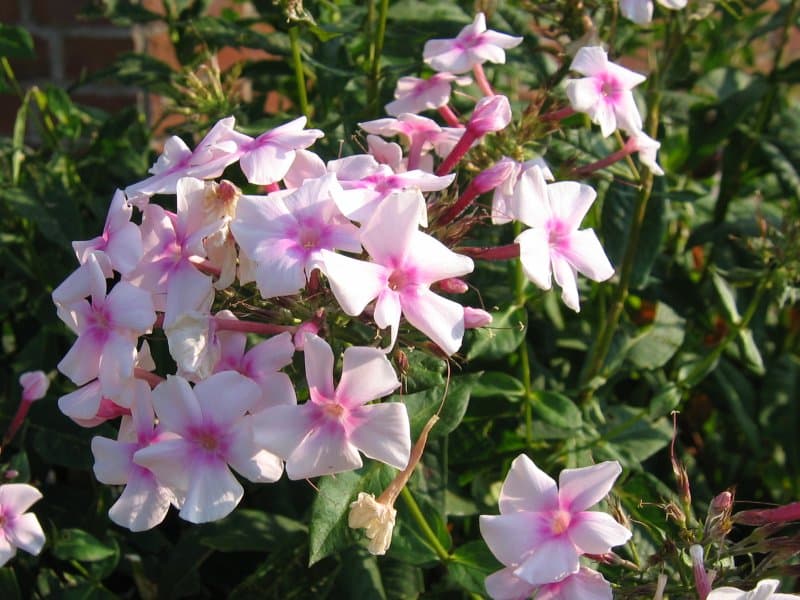
Garden phlox 'Bright Eyes'
Phlox paniculata 'Bright Eyes'
Dutch: Vlambloem 'Bright Eyes'
Vlambloem 'Bright Eyes' (Phlox paniculata 'Bright Eyes') is a perennial from the Polemoniaceae family that grows up to 100cm tall. This plant thrives in full sun to partial shade and requires moderate maintenance. Blooms in summer and late summer with pink flowers and attracts bees and butterflies.
80–100 cm
40–60 cm
full sun, partial shade
moderate
loam, clay soil
moderate maintenance
summer, late summer
pink
Ecologische waarde
Verzorgingskalender
| Taak | Jan | Feb | Mrt | Apr | Mei | Jun | Jul | Aug | Sep | Okt | Nov | Dec |
|---|---|---|---|---|---|---|---|---|---|---|---|---|
| 🌱Planten | ||||||||||||
| ✂️Snoeien | ||||||||||||
| 💧Bemesten |
Care tips
Planting
Phlox paniculata 'Bright Eyes' thrives in full sun or partial shade, though flowering is most prolific with at least six hours of direct sunlight daily. Choose a spot with good air circulation to reduce disease risk. This cultivar tolerates loam and clay soils but demands good drainage; waterlogged roots in winter can be fatal. Before planting, dig in plenty of well-rotted compost or manure to improve soil structure and moisture retention, especially important on clay. Plant container-grown phlox in March, April, May, September, or October. Autumn planting allows roots to establish before winter, but spring planting works well if you keep new plants watered through their first summer. Dig a hole slightly larger than the root ball, set the crown at soil level—never deeper—and backfill, firming gently. Space plants 45 cm apart to allow air to circulate freely between mature clumps, which helps prevent powdery mildew. Water thoroughly immediately after planting to settle soil around the roots and eliminate air pockets. Apply a 5 cm layer of organic mulch such as garden compost or bark chips around the base, keeping it a few centimetres clear of the stems to avoid rot. If planting in spring, water regularly for the first eight to ten weeks until the root system is established. Autumn-planted phlox usually needs less attention, relying on seasonal rainfall, but check during dry spells in late autumn. Staking is rarely necessary if plants receive enough light and are not overcrowded, though tall stems on exposed sites may benefit from discreet support with twiggy pea sticks inserted in mid-spring.
Pruning
Phlox paniculata 'Bright Eyes' benefits from two distinct pruning sessions. The main cut-back happens in November after flowering has finished and foliage begins to die back. Use clean secateurs or garden shears to cut all stems down to ground level, removing the entire top growth. This autumn tidy-up eliminates overwintering sites for pests and diseases, particularly powdery mildew spores, and keeps the border neat through winter. Bag up and bin (do not compost) any mildewed material. In March, as new shoots emerge, carry out a second, lighter intervention. Thin out the weakest shoots when they reach about 10–15 cm tall, leaving four to six of the strongest stems per clump. This improves air circulation through the plant and channels energy into fewer, sturdier flowering stems with larger flower heads. Some gardeners also pinch out the growing tips of half the remaining stems in late May to delay flowering on those shoots by two to three weeks, extending the overall display, though this reduces individual flower size slightly. Deadheading is not strictly pruning but makes a real difference. Remove spent flower heads throughout summer and into early autumn by cutting back to the nearest side shoot or leaf joint. This encourages a second, smaller flush of blooms and prevents self-seeding, which produces inferior seedlings that can crowd out the named variety. If you want to reduce height or prevent flopping, you can cut back all stems by one-third in late May, though this delays flowering by a week or two.
Maintenance
Water phlox regularly during the growing season, particularly from late spring through summer when flower buds form and open. Aim for one deep soak per week in dry weather, delivering water at the base rather than overhead to keep foliage dry and reduce mildew risk. Clay soils hold moisture longer, so adjust frequency accordingly; loam may need watering twice weekly in hot spells. Reduce watering after flowering finishes in early autumn, and stop altogether once stems are cut back in November. Feed in April with a general-purpose granular fertiliser such as blood, fish and bone, scattering a handful around each clump and lightly forking it into the topsoil. Apply a second feed in May as flower buds develop, and a final liquid tomato feed in June to support flowering. Avoid high-nitrogen feeds after June, which promote soft growth vulnerable to mildew. Powdery mildew is the main problem with border phlox, appearing as white, powdery patches on leaves from mid-summer onwards. Good spacing, thinning shoots in spring, and watering at soil level all help, but some infection is almost inevitable in humid summers. Badly affected leaves can be removed, though mild cases do little harm. Phlox eelworm causes distorted, thickened shoots and stunted growth; dig up and destroy affected plants immediately. Slugs occasionally damage emerging shoots in spring. Refresh the mulch layer each March to suppress weeds and conserve moisture. Phlox is fully hardy in zones 4–8 and needs no winter protection. Divide congested clumps every three to four years in March or October to maintain vigour, replanting only the healthy outer sections.
More about this plant
Combines well with
Related guides
Garden phlox 'Bright Eyes' in your garden design?
Make a free garden design with AI advice. Our AI knows Garden phlox 'Bright Eyes' and 130+ other plants.
Start free design